





What is batch blending and continuous blending?
NPK dry fertilizer batch blending plant is based on a predefined total batch weight, in which each raw material is accurately measured either sequentially or in parallel by gravimetric weighing units and then discharged collectively into a mixer for batch homogenization. After the mixing cycle is completed, the entire batch is discharged before the next cycle begins. This process achieving typical metering accuracy of ±0.2% to ±0.5%. Continuous blending meters each raw material in an uninterrupted flow and feeds them simultaneously into a continuous mixer for online blending, based on preset mass flow rates. Metering can be realized either by continuous gravimetric control, with accuracy typically ±0.5% to ±1.0%, or by volumetric control, with accuracy in the range of ±2% to ±5%. Continuous blending operates under open-loop or semi-closed-loop flow control, enabling non-stop production and significantly higher hourly capacity. So in this article we are going to compare these two system: Batch Static weighing blending vs continuous dynamic weighing blending system and give you an idea which one suits your BB fertilizer production.
Batch Blending System: Static weighing batch type plant
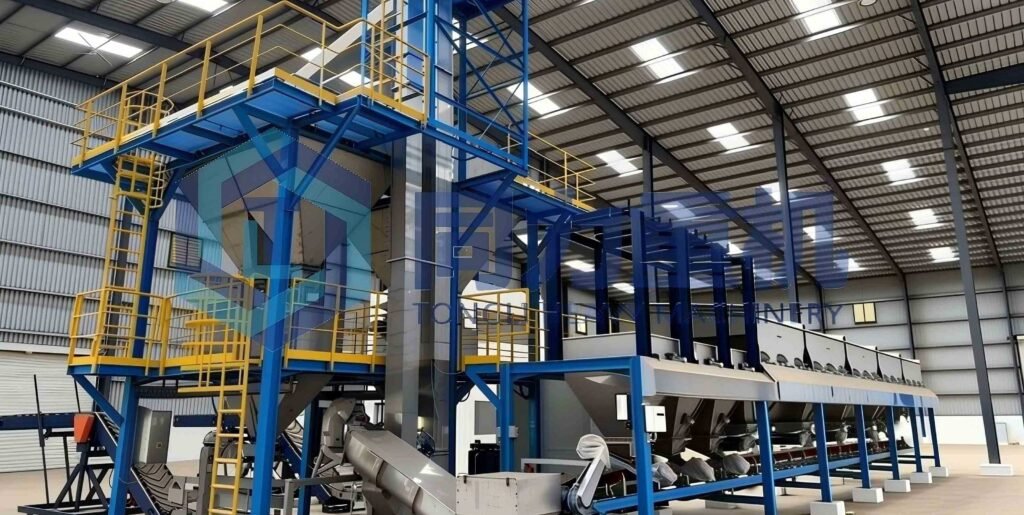
Batch-type bulk blending plants are designed for flexibility and formula diversity. Each batch is produced individually and requires refilling before the next cycle. These systems are ideal for operations producing multiple fertilizer recipes, with batch sizes typically ranging from 1 to 10 tons and throughput capacities up to 70 tons per hour. Batch blending lines can be operated manually or with entry-level automation software, and the blend cycle time can be easily adjusted. Thanks to this flexibility, batch systems are particularly well suited for custom blends, specialty fertilizers, micronutrient-rich formulas, and highly complex nutrient combinations. There are 4 types of batching blending plant:
Horizontal drum blender type
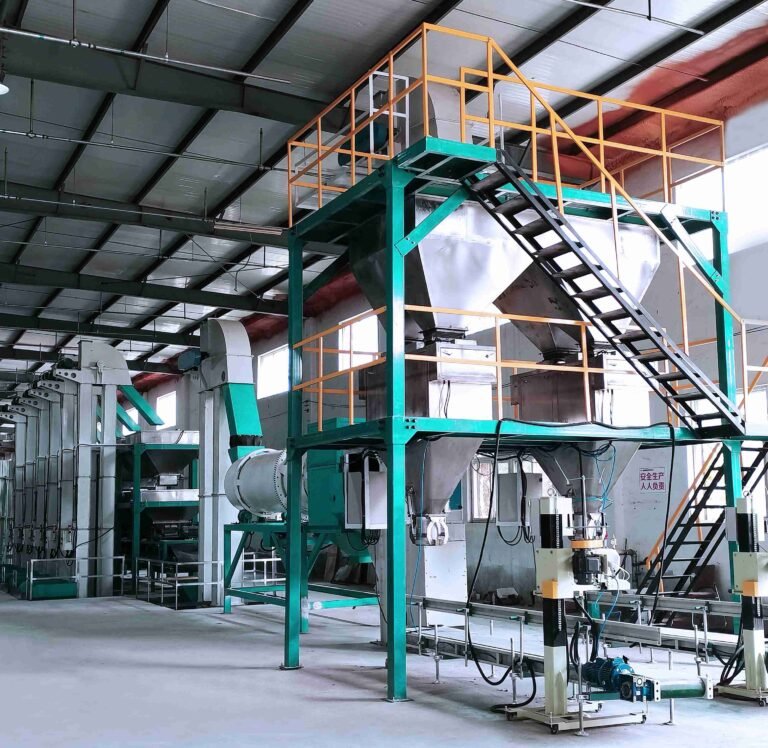
The horizontal drum blender is a high-efficiency batch mixer designed for rapid blending of granular fertilizers and bulk solids. Material is tumbled inside a rotating horizontal drum, creating intensive yet controlled mixing through continuous lifting and cascading action. This design is especially suitable for high-throughput bulk blending operations where speed is critical.
- Very fast blending cycle
- Typical blending and discharge time under 5 minutes
- Capable of processing 13 tons per batch from weigh hopper to load-out
- Simple mechanical structure with low maintenance requirements
- Well suited for granular NPK, urea, MAP, DAP, and bulk blends
- Ideal for truck or big-bag direct loading systems
Vertical Auger blender type
The vertical auger blender uses a vertically mounted screw to lift material upward while gravity returns it through the center of the vessel, forming a continuous circulation loop. This blending principle provides uniform mixing with low shear, making it suitable for both retail and wholesale fertilizer blending applications.
- Designed for high-capacity retail or wholesale blending
- Continuous or high-frequency batch operation
- Throughput capacity up to 300 tons per hour (system-dependent)
- Gentle mixing action preserves particle integrity
- Handles wide variations in bulk density and particle size
- Compact vertical footprint, suitable for plant tower layouts
Paddle blender type
The paddle blender is a horizontal, high-intensity mixer that uses rotating paddles to generate a fluidized mixing zone. This design provides rapid homogenization and excellent control over blend uniformity, especially when precise nutrient distribution is required.
- Short mixing time with high uniformity
- High mixing intensity for difficult or multi-component formulations
- Suitable for dry blending and controlled liquid addition
- Consistent performance across varying batch sizes
- Commonly used in precision fertilizer and specialty blend production
- Robust construction for continuous industrial duty
Tower style blender type
The tower style blending system integrates weighing, blending, and discharge equipment into a vertical, gravity-assisted layout. Materials flow downward through each process stage, minimizing conveying equipment and improving overall system efficiency.
- Gravity-driven material flow reduces energy consumption
- Integrated weighing, blending, and load-out in a single structure
- High automation level with minimal operator intervention
- Reduced footprint with efficient vertical space utilization
- Suitable for large-scale fertilizer blending plants
- Supports bulk truck loading, big bags, or bagging systems
Continuous Blending System: Dymanic weighing Continuous type plant
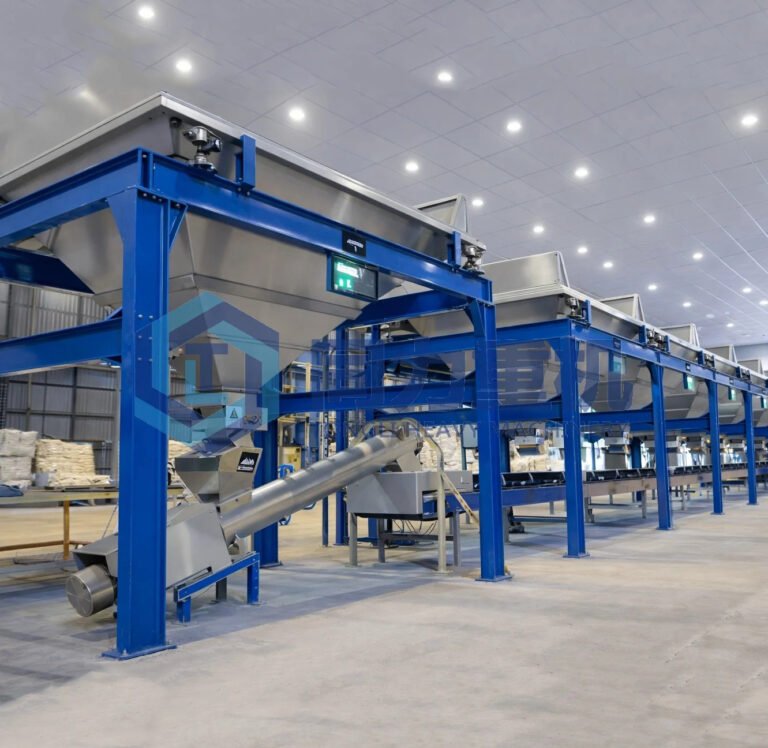
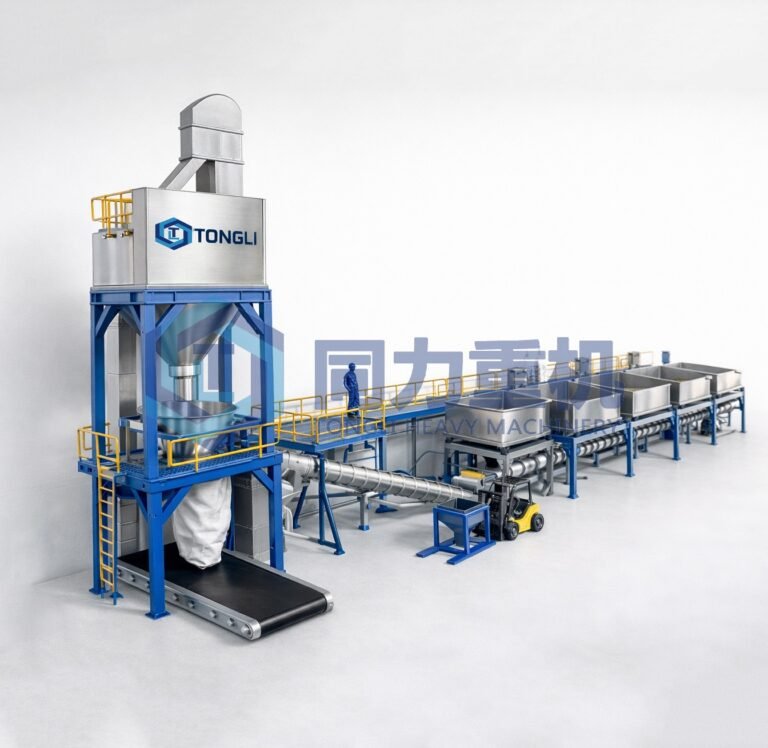
Continuous bulk blending systems are engineered for high-volume, single-formula production. Raw materials are fed continuously, and blending occurs without interruption. These plants are capable of production rates exceeding 70 tons per hour and are always equipped with fully automatic, high-level control systems. Continuous blending delivers exceptional efficiency for standardized products, but blend cycle times are not easily adjustable, and stable operation depends on the consistent, uninterrupted supply of raw materials to maintain the required output rate. For customers seeking both flexibility and capacity, Tongli also supplies combination systems that integrate batch and continuous principles, enabling producers to switch between product diversity and large-scale output as market demand changes. There are two types of declining weight belnding plant: either by weighing control or volumetric control.
By weighing control
In a weighing-controlled continuous blending system, each raw material is fed through a gravimetric feeder equipped with load cells. The feeder continuously measures the real-time weight loss of material in the hopper or feeder body. Based on the target formulation, the control system adjusts feeder speed to maintain the required mass flow rate (kg/h) for each component. The materials are then discharged simultaneously into a continuous mixer, such as a drum, paddle, or auger mixer. The system operates on a closed-loop feedback principle. Actual mass flow is constantly compared with the setpoint, and any deviation is corrected automatically by adjusting the feeder drive. This ensures accurate proportioning regardless of changes in bulk density, particle size, moisture, or material flow behavior. Because control is based on weight rather than volume, formulation accuracy remains stable over time. Gravimetric continuous blending systems are suitable for medium to very high capacities, typically ranging from 20 tons per hour up to 300 tons per hour or more, depending on feeder size and mixer selection. Proportioning accuracy can typically reach ±0.1–0.3% per component, making this system ideal for regulated fertilizer products and export-grade blends.
Adventages of Gravimetric / Loss-in-Weight blending system
- High proportioning accuracy independent of bulk density variation
- Stable blend quality during long continuous runs
- Suitable for strict nutrient uniformity regulations
- Automatic compensation for material flow fluctuations
- Ideal for multi-component and high-value formulations
- With declining weight impregnation system
- Operated by LEC’s PLC control system
Limitations disadventages of continuous declining weight fertilizer blender
- Higher initial investment compared to volumetric systems
- More complex mechanical and control systems
- Requires proper calibration and stable feeder installation
- Sensitive to vibration and structural instability if not properly designed
When to use?
- Nutrient accuracy and uniformity are critical
- Products must meet national or international fertilizer regulations or Ecowas.
- Raw materials show large density or moisture variations
- The plant operates at high throughput with long production cycles
By volumetric control
In a volumetric continuous blending system, each raw material is fed by a volumetric feeder, such as a screw feeder, belt feeder, or rotary valve. The feed rate is controlled by speed (RPM) or gate opening rather than by weight. The system assumes a relatively constant bulk density for each material, and materials are proportioned based on volume per unit time before entering the continuous mixer. This system operates on an open-loop control principle. Once the feeder speed is set, the material is delivered at a nominal volumetric rate. The formulation accuracy depends on the consistency of the raw material’s bulk density and flow characteristics. Any variation in material properties directly affects the actual mass flow rate unless manually corrected. Volumetric continuous blending systems typically operate in the range of 10 to 150 tons per hour. Proportioning accuracy is generally lower than gravimetric systems, commonly in the range of ±1–3%, depending on material stability and feeder design. However, for standard bulk blends, this level of accuracy is often acceptable.
Advantages of volumetric control fertilizer batching
- Lower equipment and installation cost
- Simple mechanical structure and control logic
- Easier operation and maintenance
- Suitable for stable, free-flowing materials
- Faster commissioning and simpler automation
Limitations of volumetric control declining weight blending
- Accuracy affected by bulk density, moisture, and segregation
- Requires frequent manual adjustment and monitoring
- Less suitable for strict formulation tolerances
- Not ideal for materials with variable flow behavior
When to use?
- Raw materials have stable density and flow properties
- Regulatory accuracy requirements are moderate
- Capital investment is limited
- The plant serves local or non-regulated markets
Comparison between volumetric control/weighing control
For modern fertilizer plants targeting high throughput, consistent quality, and regulatory compliance, weighing-controlled systems are the preferred solution. Volumetric systems remain a practical and economical option for operations with stable raw materials and less stringent quality demands.
| Selection Factor | Weighing Control | Volumetric Control |
| Measurement basis | Weight (kg/h) | Volume (m³/h) |
| Control type | Closed-loop | Open-loop |
| Accuracy | High (±0.1–0.3%) | Moderate (±1–3%) |
| Capacity | Medium to very high | Low to medium |
| Investment level | Higher | Lower |
| Regulation compliance | Excellent | Limited |
Dual Ribbon Auger
The dual ribbon auger continuous blending system is designed for high-capacity, continuous mixing of granular fertilizers, powders, and liquid additives. The mixer utilizes inner and outer counter-rotating ribbon augers to generate intensive axial and radial material movement, ensuring rapid and uniform blending. This configuration is particularly effective for applications requiring simultaneous dry blending and liquid coating within a single continuous process. In fertilizer production, the system is widely used for powder and liquid blending, including the application of coating agents, micronutrients, and conditioners onto base materials such as urea. Precise liquid injection systems enable controlled spraying and uniform distribution while maintaining continuous flow. With appropriate feeder and mixer sizing, the system can achieve throughput capacities of up to 400 tons per hour for urea, making it suitable for large-scale industrial terminals and export-oriented fertilizer operations.
On farm blend system
The on-farm blending system is designed for direct, point-of-use fertilizer blending, where speed, simplicity, and robustness are more critical than maximum metering accuracy or automation level. Unlike centralized blending plants, this system is installed close to farmland or distribution points and operates with short production cycles, enabling immediate blending and application without intermediate storage of finished products. From an engineering perspective, on-farm systems are built around simple volumetric or semi-gravimetric feeding units combined with a continuous mixer, prioritizing stable operation under variable field conditions. The equipment is typically skid-mounted or trailer-mounted, with minimal civil work and reduced electrical and control requirements. This design allows rapid deployment, easy relocation, and reliable operation by non-specialist operators, making it particularly suitable for seasonal production, local distributors, and agricultural cooperatives where operational continuity and ease of use outweigh the need for high-capacity or high-precision blending.
What is the difference between batch types blending system and continuous fertilizer blending plant?
A batch blending system weighs raw materials for one batch, mixes them for a set time, and then fully discharges before the next batch starts. It achieves high accuracy of ±0.2% to ±0.5%, supports small to medium batch sizes, and allows fast formula changes, making it ideal for customized and multi-formula BB fertilizer production. However, because production is intermittent, typical capacity is lower, commonly 10~30 tons per hour, depending on batch size and cycle time. A continuous fertilizer blending plant feeds raw materials into the mixer continuously at controlled flow rates, with blending and discharge occurring at the same time. Production runs without stopping, allowing much higher capacity, typically 30–300 tons per hour. Metering accuracy depends on the control method: ±0.5%~1.0% for gravimetric continuous systems and ±2%–5% for volumetric systems. Continuous blending is best suited for large-volume, standardized fertilizer products, but formula changes are less flexible than in batch systems.
Comparison table:
| Item | Batch Type Blending System | Continuous Blending Plant |
| Production mode | Discrete batches (one recipe per batch) | Continuous, uninterrupted production |
| Recipe flexibility | Very high, easy recipe changes | Low, designed for same recipe |
| Typical batch / volume | 1–14 tons per batch | Large volumes, no fixed batch |
| Production capacity | ≤ 70 tons/hour | ≥ 70 tons/hour (up to hundreds t/h) |
| Automation level | Manual to low-level automation | Fully automated |
| Software requirement | Basic control, no layering software | Advanced proportioning & layering software |
| Blend cycle adjustment | Easy to adjust | Difficult to adjust |
| Handling complex formulas | Excellent | Limited |
| Powder & liquid micronutrients | Easily handled | Limited, material dependent |
| Raw material requirement | Flexible material properties | Requires free-flowing materials |
| Dependence on feeding stability | Low | High |
| Installation suitability | Small capacity, on-farm / near-farm | Large centralized plants |
| High-tonnage capability | Mainly tower-type systems | Easily scalable with multiple bins |
| Capital investment | Generally lower | Generally higher |
| Raw material variety | Flexible | Limited by number of intake bins |
| Material transfer to mixer | High-speed batch discharge | Continuous feeding |
Production Capacity: Tons per Hour Comparison
Production capacity is the most visible difference between batch and continuous blending systems. Batch blending plants operate in discrete cycles, typically producing 1–14 tons per batch, with practical hourly outputs usually below 60–70 t/h, depending on weighing speed, mixer discharge time, and batch coordination. Continuous blending lines, by contrast, meter raw materials without interruption and feed them continuously into a mixer, allowing sustained outputs above 70 t/h, commonly 100–300 t/h or higher. When market demand requires long, uninterrupted production runs and high daily throughput, continuous blending becomes structurally more efficient than batch operation.
Blending Accuracy and Nutrient Uniformity
Batch blending systems achieve higher formulation accuracy because all ingredients are individually weighed to a fixed target mass before mixing, forming a closed-loop quality control process. Typical batch weighing accuracy reaches ±0.2% to ±0.5%, supporting strict nutrient uniformity standards for BB fertilizers. Continuous systems rely on mass flow control (gravimetric) or volume-based control (volumetric), where accuracy depends on feeder stability and raw material consistency. Gravimetric continuous systems generally achieve ±0.5%–1.0%, while volumetric systems may drift to ±2%–5%, making batch blending better suited for high-precision formulations.
Which System Is Better for BB Fertilizer?
Batch blending is better aligned with BB fertilizer markets that demand multiple formulas, customized nutrient ratios, and frequent recipe changes, such as specialty crops or regional soil programs. Continuous blending is better suited for standardized BB fertilizers, where one or two formulas are produced at scale for extended periods. In short, batch systems prioritize product diversity, while continuous systems prioritize production volume.
Capital Investment and Operating Cost Comparison
Batch blending plants typically require lower initial investment, especially for flat or semi-automatic configurations, as they use fewer bins, simpler control logic, and smaller mixers. Operating costs remain manageable due to lower energy consumption per cycle and simpler maintenance. Continuous blending plants often involve higher capital expenditure, driven by multiple metering feeders, advanced control software, larger material handling systems, and higher bin counts. However, at large scale, continuous systems can reduce unit production cost per ton, offsetting the higher upfront investment through volume efficiency.
Formula Flexibility and Recipe Change Time
Formula flexibility is a core strength of batch blending systems. Recipe changes are achieved by simply adjusting target weights in the control system, often requiring no mechanical changes, making batch plants ideal for frequent switching between dozens of formulations. Continuous systems require recalibration of feeder flow rates for each ingredient, and stabilization time is needed to reach steady-state accuracy. As a result, recipe changeovers in continuous blending are slower and less flexible, especially when formulas vary significantly in component ratios.
Raw Material Requirements and Flowability
Batch blending systems are more tolerant of raw material variability. Because materials are weighed statically, fluctuations in bulk density, particle size, or moisture content have minimal impact on final accuracy. Continuous blending systems, especially volumetric types, depend heavily on consistent material flow, making them sensitive to segregation, caking, or density changes. Poor flowability can directly affect feed rates and nutrient ratios, increasing deviation risk. Therefore, continuous blending performs best with uniform, free-flowing granular materials from stable supply chains.
Automation, Software, and Control Logic
Batch blending systems can operate with manual, semi-automatic, or fully automated controls, offering a wide automation range depending on budget and production needs. Their control logic focuses on batch sequencing and weight confirmation. Continuous blending systems are inherently automation-driven, relying on PLC-based flow control, proportional algorithms, and SCADA-level supervision to maintain real-time balance between feeders. Continuous plants require higher software sophistication but provide better real-time production monitoring and throughput stability.
Handling Powders and Liquid Micronutrients
Batch blending systems are structurally better suited for handling powder additives and liquid micronutrients, as these materials can be precisely dosed into a defined batch without disturbing overall flow balance. Liquids can be sprayed or injected directly during mixing, but even though the dosing is accurate but if the liquid is absorbed by the material very quickly it will cause uneven distribution. Continuous systems face challenges integrating powders and liquids due to flow instability and feeder sensitivity, often requiring additional conditioning or specialized dosing units, but in terms of evenness it is better. For BB fertilizers with trace elements or coated nutrients, batch blending offers greater formulation reliability.
On-Farm vs Centralized BB Fertilizer Production
Batch blending systems are commonly used in on-farm or near-farm setups, where production volumes are moderate and formula diversity is important. Their compact layout and simpler infrastructure requirements support decentralized fertilizer production. Continuous blending systems are better suited for centralized industrial plants, where raw material logistics, storage capacity, and distribution networks support sustained high-volume output. The choice often reflects whether fertilizer production is demand-driven locally or supply-driven at regional scale.
Small-Scale vs Large-Scale Fertilizer Plants
Small to mid-scale fertilizer producers benefit from batch blending due to lower entry cost, easier operation, and adaptability to market changes. Large-scale producers supplying standardized products to broad markets benefit from continuous blending, where economies of scale dominate decision-making. As plant size increases, continuous systems provide better alignment between equipment utilization and output demand, while batch systems may become constrained by cycle time.
Typical Plant Layouts and Configurations
Batch blending plants are available in flat layouts for small capacities or tower-type configurations for higher throughput, where gravity assists material transfer. Tower batch plants can achieve relatively high outputs but involve higher structural cost. Continuous blending plants are typically flat and modular, allowing multiple intake bins, parallel feeders, and flexible bagging or bulk load-out arrangements. This modularity enables continuous systems to scale capacity more easily by adding feeders or discharge lines.
How to Choose the Right Blending System
Selecting the right blending system requires balancing capacity demand, formula diversity, accuracy requirements, raw material quality, and budget. If production involves many formulas, frequent changeovers, powders, or micronutrients, batch blending is generally the safer choice. If production focuses on a limited number of standardized formulas with stable raw materials and high daily output targets, continuous blending provides superior efficiency. The decision should be based on long-term market strategy rather than short-term capacity needs.
Common Mistakes When Selecting a BB Fertilizer Blending Plant
A common mistake is choosing continuous blending solely for its high capacity without considering formula flexibility and raw material variability, leading to quality issues and operational instability. Another frequent error is overspending on automation for batch plants when production volumes do not justify the complexity. Underestimating future product diversification or regulatory accuracy requirements can also result in premature equipment upgrades. A proper selection should align equipment capability with realistic production scenarios and market evolution.
Combined Blending System: Combination type plant
For customers seeking both flexibility and capacity, with the standardization and high-quality development of the BB fertilizer industry, single metering approaches based solely on volumetric control or gravimetric (weighing) control are gradually being upgraded toward hybrid and optimized solutions. The core objective of this evolution is to achieve a balanced combination of accuracy, production efficiency, and investment cost, especially for producers facing diverse formulations and competitive market conditions.
Hybrid Metering Concept: Volumetric Coarse Feeding + Gravimetric Fine Dosing
The most widely adopted hybrid solution is the “volumetric coarse feeding + gravimetric fine dosing” combined metering system. In this configuration, bulk materials are first discharged rapidly using volumetric feeders to complete approximately 90%–95% of the target set weight. The remaining 5%–10% is then accurately completed by a small gravimetric weighing hopper operating in fine-dosing mode. This approach significantly improves overall production efficiency while maintaining controlled accuracy. By limiting the gravimetric system to fine correction rather than full-scale dosing, the metering accuracy can be stabilized within ±0.5% to ±1.0%, while total equipment investment is typically 30%–40% lower than a fully gravimetric system. As a result, this configuration has become the mainstream solution for small and medium-sized BB fertilizer plants.
Upgrade of Volumetric Metering Systems
Another important development trend is the intelligent enhancement of traditional volumetric metering systems. By integrating online bulk density detection sensors and variable-frequency drive (VFD) control, the system can continuously monitor changes in material bulk density during operation. Based on real-time feedback, the discharge speed of the volumetric feeder is automatically adjusted. This dynamic correction compensates for volume-to-mass conversion errors caused by variations in particle size, moisture content, or material segregation. Through this intelligent control strategy, volumetric metering accuracy can be improved to approximately ±1%–±2%, achieving a practical balance between metering precision and system cost without fully adopting gravimetric technology.
Upgrade of Gravimetric Metering for Fertilizer Blending Production
For large-scale continuous BB fertilizer production, a high-efficiency gravimetric upgrade has emerged based on multi-unit parallel weighing combined with continuous blending. In this process, multiple weighing hoppers operate simultaneously, each independently weighing different raw materials. After weighing, materials are discharged in sequence or synchronously into a continuous blender. This process concept is often described as “batch weighing + continuous blending.” It preserves the high accuracy of gravimetric control while significantly increasing line throughput. Using this configuration, production capacity can be increased to 30–50 tons per hour, approaching the efficiency level of volumetric systems while maintaining gravimetric accuracy.
When to choose volumetric metering and when to choose gravimetric metering for fertilizer blending plant?
Gravimetric metering should be selected when formulation accuracy and product consistency are the primary requirements. In high-end BB fertilizer production, especially for cash crops, greenhouse cultivation, and precision agriculture, strict control of N, P, K, and micronutrient ratios is essential. Weight-based metering ensures stable nutrient composition and minimizes formulation deviation, making it suitable for premium and customized products. Gravimetric systems are also preferred for small-batch, multi-formula production. Regional fertilizer producers often need to switch frequently between different recipes based on soil conditions and crop types. By weighing systems allow fast and accurate recipe adjustments through the control system, reducing the risk of formulation errors during product changeovers.
- High-end customized BB fertilizers for cash crops and greenhouse use
- Small batch, multi-recipe production with frequent product changeovers
- Modern plants requiring production traceability and digital management
- Raw materials with unstable bulk density, moisture, or particle size
Volumetric metering is the preferred choice when low investment cost and rapid project implementation are the main considerations. For small and medium enterprises entering BB fertilizer production, volumetric systems provide a cost-effective solution with simple structure, lower maintenance requirements, and shorter commissioning time, enabling faster start-up of production. This metering method is well suited for large-batch production of standardized formulations. Common field-crop BB fertilizers such as NPK 15-15-15 or 20-10-10 typically use fixed recipes and uniform granular raw materials. When production volume is high and formulas remain unchanged, volumetric metering can deliver sufficient accuracy while maintaining high throughput.
- Small and medium enterprises with limited capital investment
- Large-batch production of standardized BB fertilizer formulas
- Stable raw material supply (uniform urea, potash, granular NPK)
- Mobile or temporary blending systems
Quick Decision Chart
| Selection Factor | Gravimetric (By Weighing) | Volumetric |
| Metering basis | Actual weight (kg / t) | Volume (m³ / rpm) |
| Typical accuracy | ±0.3%–±0.5% | ±1%–±3% |
| Formula flexibility | Very high | Limited |
| Batch size | Small to medium | Medium to large |
| Production mode | Multi-formula, customized | Standardized, fixed formulas |
| Raw material tolerance | Excellent (density & moisture independent) | Sensitive to density variation |
| Automation level | High (PLC / data tracking) | Basic to medium |
| Investment cost | High | Low |
| Maintenance complexity | Medium–high | Low |
| Typical users | Modern / high-end plants | Cost-sensitive operations |
How much does a fertilizer blending and bagging system equipment cost?
Bulk blending plant investment levels are closely related to annual throughput capacity, measured in metric tons per annum (mtpa). Notice the below cost are the equipment only, does not taken into consideration of the workshop/civil foundation/infrastructures.
Small Capacity: 0-30,000 mtpa
For plants with a capacity of up to 30,000 mtpa, the typical capital cost ranges from USD $71,500 to USD $110,000. This capacity range generally applies to batch-type blending plants, as continuous blending systems are usually not economical or applicable at this scale.
Medium Capacity: 50,000 to 100,000 mtpa
For medium-capacity facilities producing 50,000 to 100,000 mtpa, total project costs typically fall between USD $150,000 and $200,000 USD. Plants in this range may adopt either advanced batch systems or entry-level continuous blending solutions, depending on product diversity and automation requirements.
High-capacity bulk blending plants: 100,000 to 150,000 mtpa
High-capacity bulk blending plants with annual outputs of 100,000 to 150,000 mtpa usually require an investment of approximately USD $200,000 to USD $300,000. At this level, continuous blending systems are commonly selected due to their higher throughput efficiency and fully automated operation.
High-capacity bulk blending plants: 400,000 to 500,000 mtpa
Very large-scale installations producing 400,000 to 500,000 mtpa generally involve capital expenditures in the range of USD $400,000 to USD $500,000. These plants are designed for sustained, high-volume production and rely on robust material handling, storage, and process control systems.
Ultra high-capacity bulk blending plants: 600,000 to 700,000 mtpa
For ultra-high-capacity plants exceeding 600,000 mtpa, total investment typically around $750,000. depending on automation level, storage configuration, and auxiliary systems. These projects are almost exclusively based on continuous blending technology to ensure stable operation at maximum throughput.
Now How much does a fertilizer blending and bagging system overall cost?
| Throughput Capacity (mtpa) | Typical Investment Cost (USD) |
| ≤ 30,000 mtpa | USD 3–5 million (not applicable for continuous plants) |
| 30,000 – 70,000 mtpa | USD 5–10 million |
| 70,000 – 150,000 mtpa | USD 10–15 million |
| 150,000 – 200,000 mtpa | USD 15–20 million |
| Over 200,000 mtpa | USD 20 million and above |
Continuous vs Batch Fertilizer Blending: Which Delivers Better Product Uniformity?
Continuous fertilizer blending plants outperform batch (batching) blending systems by a significant margin in product uniformity—an expert-backed conclusion for industrial fertilizer production, particularly bulk blending (BB) fertilizers—because continuous blending relies on high-precision, closed-loop feedback metering (e.g., loss-in-weight feeders) that maintains strict, real-time mass flow ratios of all NPK, fillers, and additives, with component content coefficient of variation (CV) consistently controlled to ≤2% (and up to ≤3% for high-end production), while its in-line, steady-state mixing process uses specialized continuous mixers for consistent material residence time, minimal start-stop dead zones, and direct post-mixing conveyance to packaging/loading that eliminates segregation from large-volume intermediate storage and batch transitions; in contrast, batch blending is a discrete process with inherent limitations: batch-wise weighing errors that cannot be real-time corrected, difficulty calibrating optimal mixing time (risking under-mixing or over-mixing/segregation), severe post-mixing segregation from silo storage, and batch-to-batch variability driven by raw material property changes and operational differences, resulting in typical CV values of 5%–10% (often exceeding 10% in poor conditions) and only meeting a more lenient industry acceptable threshold of ≤8%. While batch blending can achieve acceptable uniformity for small-batch, customized fertilizer formulations with strict operational controls, it cannot match the consistent, high-level uniformity of continuous blending for large-scale (≥50,000 t/a) standard fertilizer production, where uniformity is critical for crop nutrient uptake and product quality compliance. For more detail abobt "what affects the uniformity of fertilizer blending line" click here.
FAQ: Frequently Asked Questions About continuous fertilizer blending and batch type blender
The continuous blending plant can definitely meet the uniformity standards of blended fertilizer (BB fertilizer) ECOWAS. This process relies on an integrated design of variable frequency precision feeding, continuous forced mixing, and closed-loop quality control to achieve a single raw material feeding accuracy of ±0.5%~1%. After processing by a rotary drum or twin-screw continuous mixer, the coefficient of variation (CV value) of the material mixing uniformity can be stably controlled within 5%. By controlling the raw material particle size difference within 2mm, maintaining a mixing chamber residence time of 30~60 seconds, implementing online real-time sampling and detection, and incorporating anti-segregation conveying and storage designs, problems affecting uniformity such as material stratification and batching deviations can be effectively avoided.
For strict nutrient tolerance limits of ±0.3–0.5%, a continuous (in-line, loss-in-weight) blending system generally provides better regulatory compliance than a traditional batch blender, because each raw material is metered in real time by load cells or mass-flow control and automatically corrected by a PLC as density, flow, or granule size changes; this closed-loop control typically delivers nutrient deviations within ±0.2–0.3% under stable operation. Batch blending can meet regulations, but only with high-precision scales, sufficient batch size, and adequate mixing time—otherwise scale resolution limits, ingredient segregation, and weighing errors often push variability closer to ±0.5% or higher, especially for low-inclusion nutrients. In practice, where regulations are tight and frequent sampling is enforced, continuous blending is technically more robust and easier to keep consistently within tolerance.
According to our experience West Africa government inspectors prefer continuous blending records, not because batch blending is unacceptable, but because continuous systems produce clear, time-stamped, traceable data that directly links each ton of fertilizer to actual ingredient feed rates and scale readings. Loss-in-weight or mass-flow controlled continuous blenders automatically log feeder rates, cumulative weights, alarms, and deviations, making it easy for inspectors to verify compliance with ±0.3–0.5% nutrient tolerances and to trace any non-conforming product to a specific production window. Batch blending records are still accepted in most jurisdictions, but inspectors often scrutinize them more closely, since compliance depends on correct batch weights, operator actions, mixer performance, and batch-to-batch consistency rather than continuous, closed-loop verification. In practice, continuous blending data is viewed as more transparent, auditable, and defensible during regulatory inspections.
In advanced continuous blending plants, nutrient deviation is verified through a multi-layer control and validation framework combining online, offline, and traceability checks:
1. online real-time verification is implemented using near-infrared spectroscopy (NIRS) modules installed at the mixer discharge or finished-product conveyor, capable of 1–2 scans per second to estimate N, P₂O₅, and K₂O content and instantly compare measured values with recipe targets, triggering alarms when deviations approach or exceed ±0.3–0.5%.
2. Offline sampling verification remains the regulatory reference, with composite samples typically taken every 30 minutes, minimum 500 g per sample, using multi-point collection to avoid segregation bias, and analyzed by standard methods such as Kjeldahl nitrogen, molybdenum–antimony colorimetry for phosphorus, and flame photometry for potassium, which provide the final legal confirmation of nutrient deviation.
Batch blending can reduce the risk of out-of-spec fertilizer only under specific conditions, but it is not inherently safer than continuous blending. Because all ingredients in a batch are weighed before mixing, errors are theoretically confined to a single, clearly defined batch, which makes isolation and rejection straightforward; this is an advantage when batch sizes are large enough (typically ≥20–30 t), scales have sufficient resolution, and mixing time is adequate to achieve uniformity. However, batch systems lack real-time correction—once a weighing or charging error occurs, the entire batch is already off-spec, and nutrient deviations of ±0.5–1.0% are common if operator actions, scale drift, or segregation occur. By contrast, continuous loss-in-weight blending actively corrects dosing deviations and can limit off-spec material to a short time window rather than a full batch. In practice, batch blending improves traceability but does not automatically reduce out-of-spec risk unless supported by high-precision weighing, strict operating discipline, and robust mixing control.
In practical industrial operation, batch blending becomes inefficient once sustained throughput exceeds approximately 30–40 tons per hour, a threshold driven not by theoretical mixer capacity but by real-world process losses and equipment constraints.
The core limitation lies in the batch cycle itself: weighing, charging, mixing, discharge, and bin cleanout or formula changeover—which, for high-accuracy blending within ±0.3–0.5% nutrient tolerance, typically requires 10–15 minutes per batch and offers little room for compression without sacrificing uniformity. Common industrial batch mixers with effective volumes of 0.5–2 m³ can technically scale by increasing batch size, but enlarging mixer volume introduces dead zones, longer effective mixing times, and often extends total cycle time to 20 minutes or more, resulting in no meaningful gain in net hourly output and higher energy consumption per ton.
Beyond 30–40 t/h, upstream static weighing systems and feeding equipment also reach practical limits, leading to feeder congestion, scale drift, and reduced dosing precision, while manual sampling, verification, and recipe changeovers further lower effective utilization—often dropping plant operating efficiency from >85% to below 60%. In multi-formula production scenarios, this inefficiency appears at even lower capacities due to frequent cleanout and recalibration requirements, which is why batch blending is rarely selected for continuous production above 40 t/h in high-compliance fertilizer plants.
In most real-world fertilizer plants, 50–70 t/h is not a practical operating range for batch blending, but rather an upper theoretical ceiling that can only be approached under very restrictive conditions. While such capacities are sometimes claimed on paper by increasing batch size or mixer volume, sustaining ±0.3–0.5% nutrient tolerance at 50–70 t/h would require oversized mixers, extremely fast and precise static weighing, minimal formula changeovers, and long effective mixing times—conditions that rarely coexist in industrial practice. At these throughputs, batch cycle times typically extend beyond 18–25 minutes, upstream feeding systems run at or near saturation, and overall equipment utilization often drops below 55–60%, meaning the apparent capacity does not translate into stable net output. As a result, most engineers consider 30–40 t/h the practical efficiency limit for batch blending, with 50–70 t/h representing a theoretical or short-term peak capacity rather than a sustainable, regulation-compliant production mode.
In practice, annual production volumes above roughly 150,000–200,000 tons per year generally justify investing in a continuous blending system, assuming normal fertilizer operating conditions (single or double shift, mixed formulations, and regulatory tolerances of ±0.3–0.5%). At this scale, batch blending plants begin to suffer from low effective utilization (typically ≤60–65%), higher labor and quality-control costs per ton, and increasing losses during batch changeovers and cleanouts. Continuous loss-in-weight blending, by contrast, can sustain 40–80 t/h with stable dosing accuracy (±0.2–0.3%), minimal downtime between formulas, and full digital traceability, which spreads the higher initial CAPEX over a much larger tonnage and delivers a lower unit cost per ton. Below ~100,000 t/y, batch systems often remain economically rational; between 100,000–150,000 t/y the decision becomes case-specific, but beyond 200,000 t/y, continuous blending is typically the technically and economically preferred solution.
Yes, a batch blending plant can be upgraded to a higher nominal capacity, but in practice the upgrade potential is limited and often uneconomical beyond a point. Incremental increases—typically 10–20%—can be achieved by improving feeder rates, automating weighing, optimizing batch sequencing, or modestly upsizing the mixer, yet the fundamental constraint remains the batch cycle time (weighing → mixing → discharge → cleanout), which cannot be shortened without risking uniformity outside ±0.3–0.5%. Pushing capacity much further usually requires a much larger mixer, higher-speed feeding and weighing systems, and expanded surge storage, which often introduces mixing dead zones, longer effective mixing times, and higher energy use while still failing to deliver stable net throughput above 30–40 t/h. As a result, when long-term demand growth targets >40 t/h or >150,000–200,000 t/y, most plants find that retrofitting a batch system approaches the cost and complexity of installing a new continuous blending line, making direct migration to continuous blending the more reliable and cost-effective upgrade path.
In fertilizer applications, the minimum economic size of a continuous blending plant is typically about 15–20 tons per hour, which corresponds to roughly 70,000–100,000 tons per year under normal operating conditions. Below this level, the higher capital cost of loss-in-weight feeders, PLC control, and online verification cannot be efficiently amortized, and a batch system usually remains more cost-effective. Once throughput reaches ≥20 t/h, continuous blending begins to show clear economic advantages: stable dosing accuracy of ±0.2–0.3%, higher effective utilization (>85%), reduced labor per ton, minimal losses during formula changeover, and full digital traceability for regulatory audits. In practice, plants in the 100,000–150,000 t/y range are the tipping point where continuous blending becomes not only technically superior but also economically justified, especially in markets with tight nutrient tolerance enforcement.
A batch blending system has a lower initial investment than a continuous blending system in most fertilizer applications. Batch plants use simpler equipment—static or semi-automatic weighing scales, a batch mixer, and basic controls—resulting in significantly lower upfront CAPEX, especially at small to medium capacities (typically ≤20–25 t/h). Continuous blending requires multiple loss-in-weight feeders, high-precision load cells, PLC/SCADA control, and often online monitoring, which raises initial investment by 30–60% compared with a batch line of similar nominal capacity. However, while batch blending is cheaper to build, continuous blending usually delivers lower cost per ton at higher throughputs due to higher utilization, lower labor demand, reduced off-spec risk, and better regulatory compliance, making it more economical over the full life cycle once production scale increases.
Not necessarily. While continuous blending systems do have higher technical complexity, they are not inherently more expensive to maintain than batch systems when evaluated on a per-ton basis. Continuous lines use more sensors, load cells, and PLC-controlled feeders, which slightly increases planned maintenance and calibration effort, but these components are modular, standardized, and typically require only routine inspection and periodic recalibration rather than heavy mechanical work. Batch systems, by contrast, rely more on large mixers, frequent start–stop cycles, and manual interventions, which lead to higher mechanical wear, unplanned downtime, and labor-intensive maintenance, especially as capacity is pushed upward. In practice, for plants operating above 20–30 t/h, continuous blending often shows equal or lower maintenance cost per ton due to steadier operation, fewer mechanical shocks, and easier fault isolation, even though the absolute maintenance skill level required is higher.
Each additional raw-material bin drives both mechanical and control complexity. In a continuous system, every bin typically requires its own loss-in-weight feeder, including load cells, discharge devices, variable-speed drives, and PLC I/O, so adding one more bin can increase total installed cost by 8–15%, depending on bin size and accuracy class. Beyond equipment cost, more bins mean a larger steel structure, more conveyors or chutes, additional calibration time, and more formula management logic, all of which raise commissioning and maintenance effort. Economically, plants with 4–6 bins strike the best balance for most NPK and BB fertilizer formulations; expanding to 8–10 bins significantly improves formulation flexibility but materially increases CAPEX and control complexity, while offering diminishing returns unless high product diversity or frequent recipe changes are required.
A modern automation package—PLC, SCADA, load cells, VFDs, recipe management, and data logging—typically accounts for only 5–10% of total installed project cost, even in highly automated continuous blending systems. While this raises upfront CAPEX, automation sharply reduces labor, minimizes dosing errors, improves compliance with ±0.3–0.5% nutrient tolerances, and provides auditable production records, which lowers operating cost and regulatory risk over the plant’s life. In practice, automation rarely determines whether a project is “too expensive”; instead, it is usually the mechanical scope (bins, structures, conveyors, mixers) that dominates cost, making automation one of the highest-return investments in the overall project.
For customized BB fertilizer formulas, a continuous blending system is generally superior, especially when many recipes, small order sizes, or frequent changeovers are required. Continuous loss-in-weight feeders adjust dosing ratios instantly through the PLC, allowing formula changes with minimal or no line stoppage and very little transition material, while maintaining nutrient accuracy within ±0.2–0.3%. Batch blending can also produce customized formulas, but each recipe change requires a full batch cycle, bin cleanout, scale re-zeroing, and often manual verification, which increases downtime and raises the risk of cross-contamination. In practice, plants serving distributors or farms with highly variable nutrient specifications favor continuous blending for its speed, traceability, and consistency in delivering tailor-made BB products.
In a continuous blending plant, formulas can be changed as often as required—practically in minutes rather than hours. Because each ingredient is metered independently by loss-in-weight feeders, a recipe change is typically executed by updating setpoints in the PLC, with no need to stop the line or empty the mixer. In well-designed systems, the transition period is limited to the material residence time of the mixer and downstream conveyor, usually 30–120 seconds, after which the new formula is fully on-spec. As a result, continuous plants can handle dozens of formula changes per shift without meaningful loss of productivity, provided bin availability is sufficient and changeovers are properly logged for traceability.
Batch blending is not better for regional, soil-specific fertilizer products, but it can be appropriate at small scale or low annual volumes. When regional formulas are produced in limited quantities, with infrequent orders and total throughput typically below 15–20 t/h, batch systems offer lower initial investment and simple segregation of products by batch. However, as the number of soil-specific recipes increases or order sizes become smaller and more frequent, batch blending quickly loses efficiency due to repeated weighing, cleanout, and sampling. In contrast, continuous blending handles soil-specific customization more efficiently at scale, allowing rapid recipe changes with minimal transition material while maintaining ±0.3–0.5% nutrient tolerance. In practice, batch blending suits low-volume, localized programs, whereas continuous blending is preferred once regional customization must be delivered frequently, accurately, and at higher throughput.
Yes, continuous blending is well suited to seasonal demand changes, and in practice handles them more flexibly than batch systems. Continuous plants can ramp output up or down instantly by adjusting feeder setpoints and line speed, allowing the same equipment to operate efficiently at partial load (often 40–100% of design capacity) without loss of dosing accuracy. During peak seasons, throughput can be increased to 50–80 t/h (depending on design), while in off-season periods the line can run fewer hours or shifts without efficiency penalties. Batch systems, by contrast, are less flexible: running small batches increases unit cost, and frequent start–stop cycles amplify downtime and labor inefficiency. Combined with rapid recipe change capability and minimal transition losses, continuous blending provides a strong operational advantage in markets with pronounced seasonal fertilizer demand.
A continuous blending system supports future product diversification better than batch blending, particularly when diversification means more formulas, smaller order sizes, or tighter quality control. Continuous systems allow new products to be introduced simply by adding or re-programming dosing setpoints, with rapid changeovers and minimal transition material, while maintaining nutrient accuracy within ±0.2–0.3%. They also integrate more easily with additional raw-material bins, micro-ingredient feeders, coatings, or online quality monitoring as the product portfolio expands. Batch systems can add new products, but each addition increases batch changeover time, cleanout effort, and the risk of cross-contamination, which quickly erodes efficiency. In practice, when long-term strategy includes expanding into specialty, customized, or regulated BB fertilizer products, continuous blending offers far greater scalability and adaptability.
A continuous blending system is more tolerant of raw material variability than batch blending, especially in industrial fertilizer production. Continuous systems use loss-in-weight or mass-flow control with real-time feedback, allowing the PLC to automatically compensate for changes in bulk density, particle size distribution, moisture, or flowability by adjusting feeder speed to maintain the target mass ratio; as a result, nutrient accuracy can be held within ±0.2–0.3% even when raw material properties fluctuate. Batch blending, by contrast, assumes stable material characteristics during weighing and mixing—if density shifts, material bridges, or flow becomes erratic, the weighing error is locked into the entire batch with no possibility of correction, often increasing deviation risk toward ±0.5% or higher. In practice, where raw materials vary by supplier, season, or storage condition, continuous blending provides a more robust and forgiving process window.
Bulk density variation has very little impact on the accuracy of our well-designed continuous blending system, because dosing is controlled by mass, not volume. In loss-in-weight or mass-flow controlled feeders, the PLC continuously measures the actual weight reduction of each bin and automatically adjusts feeder speed to maintain the target kg/h, so changes in bulk density, particle shape, or packing do not alter the delivered nutrient ratio. In practice, even with bulk density fluctuations of ±10–15%, continuous systems can still hold nutrient accuracy within ±0.2–0.3%. The main risk arises only if density changes cause severe flow instability (bridging, rat-holing, surging), which can temporarily disturb feeder stability; this is mitigated through proper bin design, agitation, and real-time deviation alarms. Overall, continuous blending is inherently robust against bulk density variation compared with volume-based or batch systems.
Yes, continuous blending can handle recycled or returned fertilizer, returned material can be reintroduced through a dedicated reclaim bin or controlled recycle feeder operating in loss-in-weight mode, allowing its inclusion rate to be precisely limited (for example 2–10% of total throughput) so that nutrient ratios remain within ±0.3–0.5% tolerance. Because continuous systems meter by mass in real time, variations in recycled material bulk density or granule size can be compensated automatically, and the PLC can enforce maximum recycle percentages to prevent over-dosing. The key constraints are material quality and consistency: recycled fertilizer must be screened to remove fines and contaminants, and its nutrient composition must be known or conservatively estimated. When these controls are in place, continuous blending integrates recycle streams with lower deviation risk and better traceability than batch systems, where returned material errors are locked into an entire batch and harder to isolate.
A continuous blending system performs better with poor-flowing materials, because it uses active feeding and real-time mass feedback to detect and correct flow instability. Loss-in-weight feeders can compensate for erratic discharge caused by moisture, fines, or irregular granules by adjusting feeder speed to maintain the target kg/h, keeping nutrient accuracy typically within ±0.3% even when flowability fluctuates. In contrast, batch blending relies on stable gravity flow during weighing; if materials bridge, rat-hole, or surge, the weighing error is locked into the entire batch with no possibility of correction, often leading to off-spec product. That said, continuous systems are not “plug-and-play” for bad materials—proper bin geometry, agitation, anti-bridging devices, and feeder selection are critical. When these are in place, continuous blending is more tolerant and controllable than batch blending for poor-flowing
Yes, moisture fluctuations have a strong impact on volumetric feeders, and this is one of their main limitations in fertilizer blending. Volumetric feeders dose material by volume rather than mass, so when moisture content changes, bulk density and flow characteristics change with it; a moisture increase of just 1–2% can shift bulk density by 5–10%, causing proportional errors in actual kg/h delivery and pushing nutrient deviation well beyond ±0.5%. Moisture also worsens flowability, leading to bridging, surging, or compaction, which further destabilizes volumetric accuracy. Because volumetric systems lack real-time weight feedback, these errors go undetected unless frequent manual recalibration is performed. For this reason, volumetric feeders are highly sensitive to moisture variation and are generally unsuitable for applications requiring tight nutrient tolerances.
A continuous blending system is better for powder micronutrients than batch blending, especially when inclusion rates are low and accuracy requirements are tight. In continuous plants, micronutrients can be dosed through dedicated micro loss-in-weight feeders with resolution down to ±0.1–0.2% of setpoint, allowing stable and traceable addition even at dosing rates of only a few kilograms per hour. Real-time mass feedback compensates for bulk density changes, moisture, and poor flowability, which are common with fine powders. In batch blending, powder micronutrients are typically charged manually or via coarse weighing, making them prone to segregation, dust loss, and batch-to-batch variability—small absolute errors can translate into large percentage deviations. In practice, when micronutrient accuracy and regulatory compliance matter, continuous blending provides far superior control and repeatability.
Yes, continuous blending can accurately dose liquid additives, and in fact it often does so more precisely than batch systems. Liquid nutrients, binders, or coatings are typically metered using mass flow meters or high-precision metering pumps linked to the PLC, allowing dosing accuracy of ±0.2–0.5% relative to setpoint. Because liquid flow is continuously monitored and corrected in real time, changes in temperature, viscosity, or pump performance can be compensated automatically. In batch blending, liquids are often added by timed pumping or volumetric measurement, which is more sensitive to viscosity and operator variation and can lead to uneven distribution. With correct nozzle placement, atomization, and synchronization with solids flow, continuous blending achieves stable, uniform liquid addition with full traceability.
Batch blending does not reduce micronutrient segregation, and in many cases it can make segregation more likely if not carefully controlled. While batch mixing allows all ingredients to be combined at once, fine micronutrient powders or small granules tend to segregate during discharge, conveying, and storage due to differences in particle size, density, and shape—especially after the mixer has done its job. Because batch systems rely on a single mixing event, any segregation that occurs afterward is not corrected, and small absolute dosing errors can affect the entire batch. Continuous blending, by contrast, can meter micronutrients at controlled rates and reintroduce them closer to the point of discharge, reducing residence time and handling steps where segregation occurs. In practice, segregation control depends more on particle compatibility, feeder design, and discharge handling than on whether the system is batch or continuous, but continuous systems generally offer better tools to manage micronutrient uniformity.
Coating liquids are applied in-line and proportionally to solids flow, using a controlled coating tank and metering pump. The liquid—such as oil, polymer, anti-caking agent, or nutrient solution—is metered by mass flow meters or precision metering pumps linked directly to the PLC, which synchronizes liquid flow with the instantaneous solids throughput (kg liquid per ton of product). Application typically occurs after blending but before final discharge, via spray nozzles or atomizing lances installed in a rotating drum, coating mixer, or conveyor hood, ensuring uniform distribution while minimizing over-wetting. Real-time feedback allows dosing accuracy of ±0.2–0.5%, and alarms are triggered if flow deviates from set limits. Because the process is continuous, coating thickness remains consistent across the entire production run, with minimal start/stop losses and full traceability tied to production tonnage.
Micronutrient use is usuallylimited by dosing accuracy, material handling behavior, and process residence time rather than by formulation demand itself. At throughputs of 40–80 t/h, micronutrients are often added at very low inclusion rates (sometimes <0.1–0.3%), where even small absolute dosing errors translate into large percentage deviations, making feeder resolution and stability critical. Fine powders also introduce challenges such as poor flowability, dusting, segregation, and adhesion to equipment, which become more pronounced as line speed increases and residence time shortens. In addition, rapid product movement leaves less opportunity for dispersion, so improper injection location or inadequate mixing energy can result in non-uniform distribution. As a result, the practical limits on micronutrient use in high-capacity plants are defined by the ability to maintain stable micro-feeding, effective dispersion, and verifiable compliance—not by plant throughput alone—making specialized micro-feeders, controlled injection points, and robust QA systems essential at scale.
Batch blending provides clearer batch traceability, because each production lot is defined by a discrete, time-bounded batch with known ingredient weights, mixer ID, and sampling results that can be directly linked to a specific quantity of finished product. This makes isolation, hold, or recall of off-spec material straightforward at the batch level. That said, continuous blending can achieve equal or better traceability using automated system: production is segmented into time- or tonnage-based “virtual batches”, with feeder rates, cumulative weights, alarms, and recipe changes logged continuously by the PLC/SCADA. Inspectors increasingly accept this model because it provides higher-resolution, time-stamped data and allows off-spec material to be confined to short production windows rather than an entire batch. In practice, batch systems are simpler to understand, but modern continuous systems deliver more precise and defensible traceability when digital records are fully implemented.
Yes—continuous blending is better for comprehensive production data logging, and in most modern plants it provides more detailed and reliable records than batch systems. Because all ingredients are metered in real time by loss-in-weight feeders, the PLC/SCADA system continuously logs actual feed rates (kg/h), cumulative weights per component, recipe setpoints, deviations, alarms, and timestamps, allowing production to be segmented into time- or tonnage-based “virtual batches.” This creates a complete, auditable data trail that links every ton of finished fertilizer to its exact formulation and operating conditions, which is highly valued for regulatory compliance, quality audits, and process optimization. In practice, continuous systems offer finer resolution and better traceability than manual or semi-automatic batch records.
Yes, batch blending is compatible with modern MES and ERP systems, but the depth and quality of integration are typically more limited than with continuous blending. Batch plants can exchange batch IDs, recipes, target weights, production quantities, and lab results with MES/ERP platforms, usually through PLC batch reports or manual confirmation steps. However, much of the data is event-based and batch-level, relying on correct operator actions and post-batch entries. Continuous blending integrates more naturally with MES/ERP because it generates automatic, time-stamped, high-resolution production data (feeder rates, cumulative weights, deviations) that can be mapped to virtual batches without manual intervention. In practice, batch systems can meet MES/ERP requirements, but continuous systems provide richer, more reliable, and more automation-friendly data streams for modern digital manufacturing environments.
Continuous blending is generally easier to audit than batch blending in modern fertilizer plants, especially where digital records and tight nutrient tolerances are required. Continuous systems automatically generate time-stamped, tamper-resistant production logs—including feeder rates, cumulative weights, recipe setpoints, deviations, alarms, and formula changes—which allow auditors to trace every ton of product to verified dosing data and to isolate any non-conforming material to a short time window. Batch blending is still auditable, but it relies more heavily on discrete batch reports, operator actions, and post-batch sampling, which auditors often scrutinize more closely for gaps or inconsistencies. In practice, while batch records are simpler conceptually, continuous blending provides more transparent, higher-resolution, and more defensible audit trails, making it the preferred system from an inspection and compliance standpoint.
Yes, one plant can combine batch and continuous blending, and in practice many modern fertilizer facilities do exactly that to balance flexibility, cost, and capacity. A common configuration is a continuous loss-in-weight blending line for high-volume, standard BB or NPK formulas, paired with a smaller batch blending system for low-volume, specialty, or trial products (micronutrient-rich, region-specific, or R&D formulas). Shared infrastructure such as raw-material bins, conveyors, surge hoppers, packaging, and data systems can serve both lines, while each blending method operates where it is most efficient. This hybrid approach allows the plant to run 40–80 t/h continuously during peak demand while still handling small, customized orders without disrupting mainline production, making it a proven and scalable plant design strategy.
In continuous blending, deviation is detected in real time and in-line through a combination of loss-in-weight feeder feedback, PLC calculations, and optional online analyzers. Each raw material feeder continuously reports actual mass flow (kg/h), and the control system compares real dosing ratios against the recipe setpoints on a second-by-second basis. If any component deviates beyond preset limits (often tighter than the legal ±0.3–0.5%), the system either auto-corrects feeder speed or triggers alarms while logging the exact time window, magnitude, and duration of the deviation. In advanced plants, this is supplemented by online NIRS or flow correlation checks, allowing deviation to be detected within seconds to minutes, limiting off-spec product to a very small quantity.
In batch blending, real-time detection is much more limited because quality is only known after the batch is completed. Control relies on confirming that each ingredient weight matches the target during charging, but once mixing starts, there is no further correction capability. Quality deviation is typically identified through post-mix sampling and laboratory analysis, or at best by indirect indicators such as weighing errors or mixer alarms. If a deviation is found, the entire batch is considered suspect, since there is no time-resolved data to isolate a smaller portion.
A combined gravimetric–volumetric blending system is a precision feeding solution for BB fertilizer production that pairs high-accuracy gravimetric metering (±0.2~0.5%) via load cell-equipped feeders for critical N/P/K nutrients with cost-efficient fixed-displacement volumetric feeding (±1~2%) for low-tolerance additives/fillers; its central PLC syncs the two via pre-calibrated mass-volume conversion logic, modulates feeder speeds in real time using inline flow sensors to maintain formulation ratios, and delivers a cost-optimized balance of strict nutrient precision and uninterrupted continuous feeding to downstream mixers, cutting high-precision gravimetric hardware costs by 30~40% versus full gravimetric setups while eliminating the poor accuracy of pure volumetric systems.
Yes, continuous-batch combined systems are a definitive future trend for BB fertilizer plants, balancing high-precision batching (±0.2~0.5% via batch gravimetric weighing) and uninterrupted continuous mixing via surge hopper buffering and PLC-synced metered discharge; this hybrid design cuts high-cost full-continuous gravimetric investment by 30~40% while avoiding full-batch inefficiency, ideal for medium-to-large lines (30~100 t/h) needing both strict nutrient tolerance and flexible multi-formula production. Driven by precision agriculture, policy-led fertilizer efficiency gains, and digital integration (IoT, NIR inline sensing, digital twins), these systems enable real-time recipe adjustment, 90%+ equipment uptime, and 20~28% lower energy use versus standalone setups; their modular quick-switch feeders reduce changeover to <15 minutes, supporting 50+ annual formulas, while data-driven control aligns with "soil testing + customized blending" models adopted by 40% of smart fertilizer stations by 2025. For plants targeting 30,000~100,000 t/y with both scale and customization, this hybrid architecture will dominate new builds and retrofits by 2030, outperforming one-size-fits-all continuous or batch-only systems.
Yes, batch weighing can feed a continuous mixer for BB fertilizer production via a buffered hopper with level-sensing and metered discharge system: batch gravimetric scales perform high-precision (±0.2~0.5%) batching of core N/P/K raw materials and additives in discrete batches, which are then transferred to a surge hopper outfitted with ultrasonic or radar level sensors and a variable-speed volumetric discharge feeder (screw/rotary vane); the feeder modulates discharge rate in real time based on mixer material demand and hopper level, maintaining a constant material flow into the continuous mixer to avoid feed interruptions or overloading, while the PLC control unit syncs batch weighing cycles with discharge speed to ensure the blended material ratio aligns with formulation specs, enabling batch weighing’s precision to pair with continuous mixing’s efficiency—this setup is widely used in medium-capacity lines (≤40 t/h) where high nutrient accuracy is required without full continuous gravimetric feeding investment.
Yes, it is possible to switch a batch blending plant to a continuous blending system, but in practice it is a partial conversion rather than a simple retrofit, and feasibility depends on how the original plant was designed. Most batch plants can reuse part of the existing infrastructure—such as raw-material storage bins, structural steel, conveyors, elevators, surge hoppers, and packaging systems—but the core blending section must be fundamentally changed. Continuous blending requires individual loss-in-weight feeders under each bin, continuous discharge geometry, PLC/SCADA control, and steady downstream flow, whereas batch plants are built around a mixer-centric, start–stop cycle. As a result, the batch mixer is often bypassed or removed, and significant modifications are needed to bin outlets, feeder mounting, control philosophy, and electrical/instrumentation systems.
From an economic standpoint, such a conversion typically costs 60–80% of a new continuous line, because the most expensive elements—precision feeders, automation, and commissioning—are new. Therefore, conversion makes sense mainly when the plant already has suitable bins, layout space, and long-term demand growth (>40 t/h or >150,000–200,000 t/y). Otherwise, many operators find that installing a new dedicated continuous blending line alongside the existing batch system delivers better return with less operational disruption.
A batch blending system is the optimal first investment for BB fertilizer production, especially for new entrants and those targeting developing/regional markets—its core strengths align perfectly with the priorities of a first-time setup: low upfront capital (30–50% less than continuous systems), minimal labor needs (2–3 general workers per shift for ≤40 t/h capacity, only 1 extra for moderate scaling), and simple operation/maintenance with no requirement for highly skilled technical staff. It features fast installation (2–4 weeks vs 6–10 weeks for continuous systems) for quick commissioning and revenue generation, robust modular components that are easy to source and maintain locally, and flexible small-to-medium batch production that adapts to fragmented regional demand (e.g., custom formulas for local soil needs) and variable raw material quality—all while meeting basic BB fertilizer uniformity standards without high-cost inline detection or complex closed-loop control. The batch system also offers low-risk scalability: you can start with a compact setup for initial market testing, then add extra mixers or hoppers to boost capacity (up to ~40 t/h) with minimal extra labor/capital, avoiding the over-investment and operational complexity of a continuous system that demands skilled operators, stable utility access, and large-scale, consistent production to justify its costs. For a first investment focused on cost control, low operational risk, adaptability, and quick market entry, the batch system strikes the ideal balance of functionality, affordability, and practicality—with the option to upgrade to a continuous/combined system later as production volume and market reach scale significantly.
First-time BB fertilizer investors often make structural decisions too early and too cheaply, which later limit capacity, quality, and compliance. The most common mistakes include:
1. Choosing batch blending solely to minimize CAPEX, without accounting for future volume growth, tighter nutrient tolerances (±0.3–0.5%), or rising labor costs—leading to early bottlenecks at 30–40 t/h and costly retrofits.
2. Underestimating regulatory enforcement, assuming label tolerances are “flexible,” and selecting volumetric or low-precision systems that cannot consistently pass random sampling and audits.
3. Overloading a simple plant with too many formulas, ignoring the real downtime caused by cleanout, recalibration, and sampling between batches.
4. Ignoring raw-material variability, such as moisture, bulk density, and particle size differences between suppliers, which quickly destabilize low-accuracy feeding systems.
5. Designing too many bins without a feeding strategy, increasing CAPEX and complexity without matching feeder accuracy or control logic.
6. Treating automation as optional, rather than as insurance for quality, traceability, and audit defense—manual records rarely survive serious inspections.
7. Focusing on nameplate capacity instead of effective throughput, overlooking that utilization can fall below 60% in poorly designed batch plants.
8. Skipping future-proofing, such as space for extra bins, micro-feeders, recycle streams, or continuous upgrades, which locks the plant into a short technical life.
For more details about "what to consider before investing a fertilizer blending plant click here"
Batch type blending systems take 30% less installation time than continuous blending systems for BB fertilizer production: a standard batch system (≤40 t/h) typically installs in 2 weeks, with its modular, compact design (integrated batch scales + fixed mixers, minimal interconnection) requiring only basic civil works and simple PLC calibration; a continuous system (≥40 t/h), by contrast, needs 3 weeks for installation, due to its complex, full-line integration—including multi-point gravimetric/volumetric feeders, continuous mixers, surge hoppers, inline NIR detection, and closed-loop control wiring—plus precise alignment of material flow paths and rigorous calibration of real-time sync logic to eliminate cumulative feeding deviations.
For BB fertilizer production with limited labor, a batch blending system is far easier to operate—with clear staffing differences tied to capacity, all at the same output vs a continuous system. At small-to-medium capacity (≤40 t/h), a batch system needs just 2–3 workers per shift to handle full operations (batch weighing, mixing, discharge, and occasional silo refills); silo refills are intermittent and manageable by the same team, with no constant real-time oversight required. A continuous system at the same ≤40 t/h capacity demands 4–5 skilled operators per shift for round-the-clock monitoring of feeders, sensors and closed-loop control, leaving little bandwidth for refills without extra labor. At large capacity (≥40 t/h), batch systems only add 1 extra worker (3–4 total) to manage more frequent silo refills (a basic, untrained task), while continuous systems scale to 6–7 skilled operators per shift—needing dedicated staff for full-line sync, real-time troubleshooting and high-speed conveyance oversight, on top of refills. Batch systems avoid the continuous system’s demand for specialized labor for constant dynamic parameter adjustment, making it the labor-efficient choice at every capacity scale. For details of "how to operate a bulk blending fertilizer plant click here"
Batch blending systems are far better suited for developing BB fertilizer markets, aligning with core local needs of limited labor, lower upfront investment, flexible small-to-medium capacity (≤40 t/h), and simpler operation—they require just 2–3 general workers per shift (only 1 extra for scaled-up capacity) to handle full operations including silo refills, with minimal need for skilled technical staff, and their lower capital cost (30–50% less than continuous systems) and shorter 2–4 week installation time match constrained budget and fast commissioning demands. Unlike continuous systems that rely on skilled operators, complex closed-loop control, and stable utility access (critical for uninterrupted production), batch systems feature straightforward step-by-step workflows, robust modular components with easy local maintenance, and adaptability to variable raw material quality and small-batch, multi-formula production (for regional soil/nutrient needs)—all while meeting local BB fertilizer uniformity standards with no need for high-cost inline NIR detection or gravimetric-volumetric integration. Scalable with minimal extra labor and capital, batch systems also avoid the continuous system’s high operational and maintenance costs (e.g., for sensor calibration, closed-loop logic upkeep), making them the pragmatic, cost-effective fit for developing markets where labor skill, capital, and technical support are limited, and production demand is fragmented and medium-scaled.
The ECOWAS fertilizer industry standard is governed by Regulation C/REG.13/12/12 (2012)—the core regional rule for fertilizer quality control—supported by technical inspection/analysis manuals, a 2022 Fertilizer Bulk Blending Guide, and oversight from the West African Committee for Fertilizer Control (WACoFeC), all aligned with AOAC/ISO testing methods and EU norms to harmonize regional practices, enable free cross-border fertilizer movement, and enforce truth-in-labeling. This standard mandates strict nutrient/weight tolerances for all fertilizer types (including bulk blended fertilizers), prohibits adulteration with harmful substances/heavy metals above set limits and noxious materials, requires comprehensive labeling (showing N-P-K guaranteed analysis, grade, manufacturer/importer details, net weight, and usage instructions) for both packaged (50kg standard sealed/tamper-evident bags, with alternative sizes permitted) and bulk shipments (equivalent written specs), and outlines mandatory sampling/inspection protocols at all production, storage, and sales stages, with national Fertilizer Inspectors detaining non-compliant products and imposing penalties for violations like misbranding or nutrient shortfalls. It eschews mandatory product registration in favor of label compliance, unifies quality control workflows across ECOWAS member states, and is further supported by the EnGRAIS project (2018–2026) to align national rules with regional regulation, while the 2022 Bulk Blending Guide provides operational best practices for blending processes to meet uniformity and safety benchmarks. For more details about "bulk blending fertilizer industry standards" click here.
Conclusion:
With over 65+years of experience in fertilizer machinery manufacturing, Tongli Heavy Machinery supplies complete bulk blending solutions covering batch blending, continuous blending, and combined blending systems. Each blending type serves different production needs: batch systems offer high flexibility for multiple formulas and complex blends, typically producing 1–10 ton batches at up to 45 t/h, while continuous systems are designed for large-volume, single-recipe production with capacities exceeding 70 t/h and fully automatic, high-level control. By offering all three technologies, Tongli enables customers to select the most suitable bulk blending plant based on budget, annual output, formulation requirements, automation level, plant layout, and material handling conditions. When selecting the most appropriate bulk blending plant, Tongli works closely with customers to evaluate all critical factors, including capital budget, annual production volume, number and types of blends, required primary, secondary, and micronutrients, performance expectations, plant layout and dimensions, seasonal demand patterns, raw material storage configuration, loading and handling equipment, as well as the technical support and service capability of the plant supplier.