





Introduction:
In both NPK compound fertilizer production lines and cement gridning Vertical roller mill VRM plants, bucket elevators are indispensable for reliable vertical conveying of bulk materials. Among the commonly used types are the TH ring chain bucket elevator, the TGD steel-cord rubber belt elevator, and the NE/NSE plate chain bucket elevator-the focus of this article. The NE-type plate chain elevator is known for its high lifting capacity, long service life, and stable operation under heavy loads. It utilizes several kinds of plate chains (block chains), such as forged block chains, welded plate chains, and high-strength alloy block chains, each designed to meet different strength and wear-resistance demands. In the following article, we will take a closer look at the distinct features, structural composition, and tensile performance of each chain type, and explain why plate chain vertical conveying bucket elevators have become the preferred choice for modern fertilizer and cement conveying systems. But most importantly, a introduction to our latest innovation—the TL series bucket elevators-engineered for superior performance and reliability in every lifting application. So lets begin! first of all let us introduce the type of block chain bushing roller sprocket.
Bucket elevator plate chain - double row design
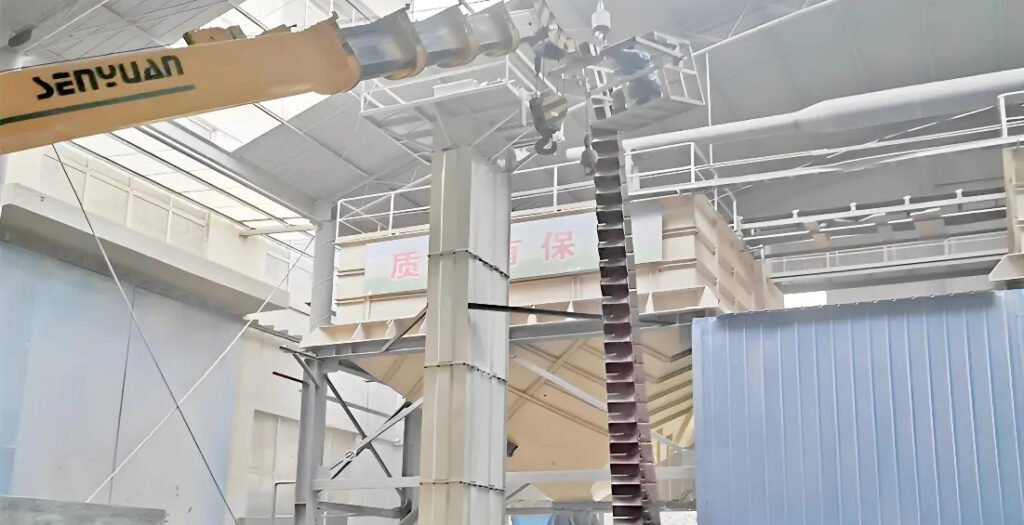
First of all we need to know the definition of double row plate chain design: two parallel plate chains are installed within the two column channels of the hoist. The bucket is fixed across the two chains by pins, forming a synchronously driven double-chain hoisting system.The NE bucket elevator adopts a dual plate chain configuration, where two identical chains are symmetrically arranged on both sides of the elevator casing. Each chain runs over the upper drive sprocket and the lower tensioning sprocket, forming a closed-loop lifting system. Each plate chain assembly consists of:
- Chain plates: Flat, heat-treated alloy steel plates designed for high tensile strength and fatigue resistance.
- Pins and bushings: Precisely machined connecting pins and inner bushings that ensure accurate chain articulation and smooth motion.
- Rollers: Hardened rollers mounted between the plates to reduce friction between the chain and the guide rails during operation.
Chain Plate Material:
Typically made of 45# steel. This material undergoes special treatment, resulting in high strength and good plasticity and toughness, capable of withstanding the tensile and impact forces transmitted from the hopper.
Pin, Sleeve, and Roller Material:
Generally made of 40Cr. 40Cr is a medium-carbon alloy structural steel. After quenching and tempering heat treatment, it possesses excellent comprehensive mechanical properties, especially wear resistance and fatigue resistance and 40 Cr this material also coomply to the United States ASTM standards.
Upper and Lower Sprockets Material:
Typically made of ZG310-570, with overall quenching and tempering treatment, achieving a hardness of HB229-269. After tooth surface quenching, the hardness reaches HRC40-48, improving the sprocket's wear resistance and service life. The NE plate chain pins are made of manganese steel, treated with high-temperature quenching to ensure a longer service life.
Tensioning Device dual plate chain:
Tensiong device for dual plate chain bucket elevator is located at the bottom section, the tensioning system ensures the dual chain remains properly engaged with the sprocket teeth. Proper tensioning prevents chain slippage, bucket misalignment, and impact loads during startup and stopping. Notice there are two type of tensioning device or you call take up device:
Features of dual chains plate chain vertical conveying bucket elevator
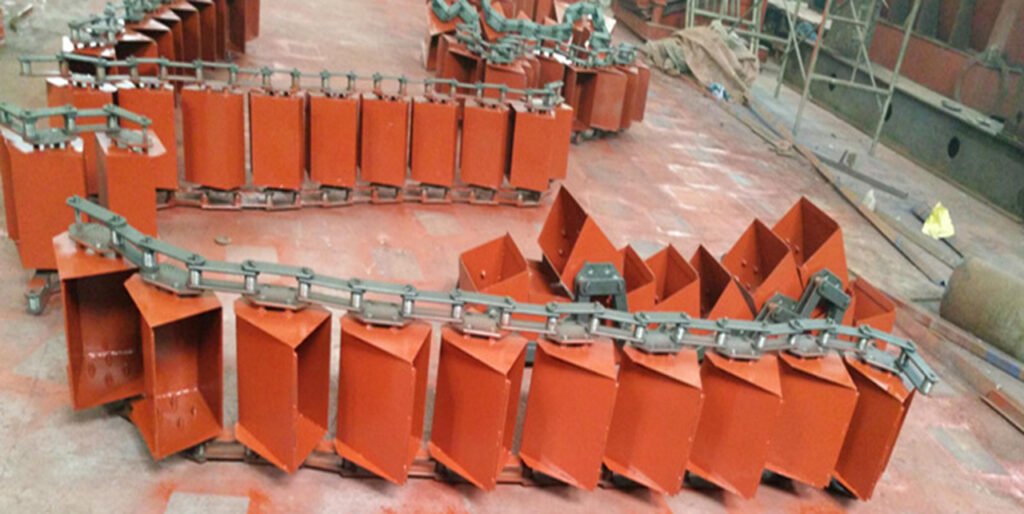
1. The high-strength alloy steel material undergoes quenching and carburizing treatment, which significantly enhances tensile capacity, surface hardness, and wear resistance.
2. Higher load-bearing capacity: The dual chains distribute the load, reducing the stress on a single chain and increasing the overall lifting capacity by over 30%.
3. Smoother operation: The two chains operate synchronously, preventing the hopper from tilting or swaying, reducing wear and noise.
4. Longer lifespan: The plate chain undergoes quenching and carburizing treatments, resulting in high wear resistance and a service life 2-3 times that of the ring chain.
5. Easy maintenance: The dual chains are installed independently; if one side is damaged, only the chain link or hopper can be replaced.
6. Safe and reliable: Equipped with a backstop and anti-derailment device, it effectively prevents chain drop or material backflow accidents.
Bucket Elevator Single Plate Chain Design:
The single-chain bucket elevator is a vertical lifting equipment that uses one central traction chain to drive the buckets. This design is commonly used in models such as HL or TB series elevators and is suitable for low to medium capacity lifting of powdery or granular materials like coal powder, cement, fertilizer raw materials, fly ash. Compare with the double chain type (NE/NSE), the single chain structure is simpler, lighter, and easier to maintain, but has lower load balance and strength.
Structural Composition features of a single plate chain bucket elevator
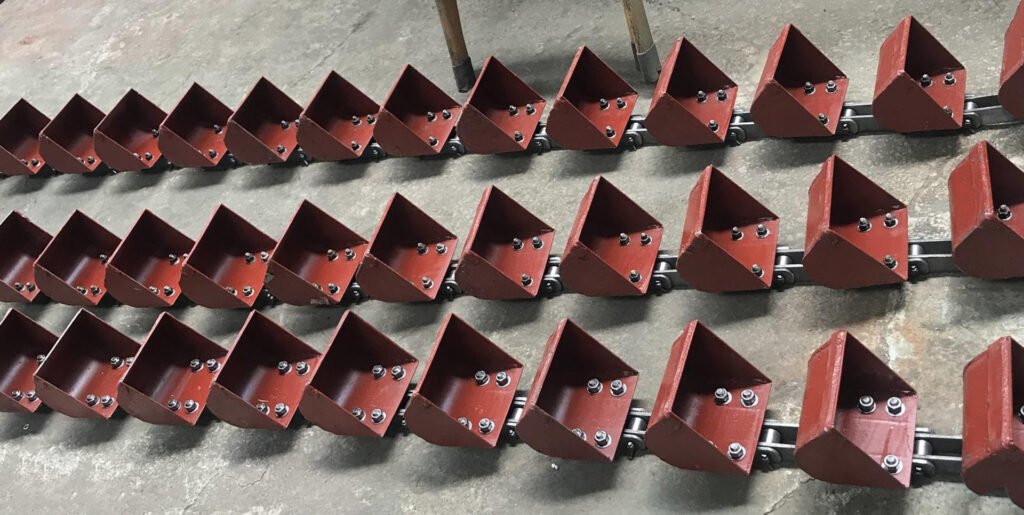
- The elevator uses one main plate chain, located in the center of the elevator casing.
- The chain runs vertically, looping around the top drive sprocket and bottom tensioning sprocket.
- Each chain link is made up of chain plates, pins, bushings, and rollers, similar to those in the double-chain type but arranged in a single line instead of two parallel sides.
- The material is typically high-strength alloy steel, heat-treated for durability and wear resistance.
- Because the load is supported by only one chain, the design requires precise alignment and uniform bucket loading to avoid side stress and oscillation.
Single row plate chain bucket feature:
Buckets are mounted on one side of the chain through connecting pins or attachments. To maintain balance, the center of gravity of each bucket is carefully designed to align with the vertical chain line. The buckets are usually narrower and lighter than those used in double-chain models to minimize torque and chain deflection. Materials may include carbon steel, manganese steel, or reinforced polymer, depending on the conveyed medium.
Single row plate chain drive assembly feature:
This system is compact and cost-efficient, suitable for smaller capacity applications or limited space installations. The head section contains the drive sprocket, main shaft, and motor reducer unit. The drive sprocket engages with the single chain, transmitting torque for vertical lifting. A backstop device can also be installed to prevent reverse rotation during emergency stops.
What are the parts of bucket elevator single plate chain
1. Chain Plates (Outer and Inner Plates)
- The chain plates are flat, elongated links with precise pitch spacing that defines the chain length and bucket interval.
- In a single-chain design, each pair of plates connects to the adjacent one through pins and bushings, forming a rigid yet flexible vertical traction body.
- The pitch (distance between two pins) typically ranges from 125 mm to 250 mm, depending on the elevator model (e.g., HL200, HL250).
- The chain plate thickness is designed to handle high tensile loads, usually 6–10 mm for medium elevators and up to 14–16 mm for heavy-duty designs.
2. Pins (Connecting Shafts)
- Precision-machined alloy steel pins pass through the inner bushings, connecting the plates on both sides.
- The pins act as pivot points, allowing controlled flexibility for the chain to rotate smoothly over the sprockets.
- The surface is case-hardened or induction-hardened to improve wear resistance, especially at the bearing contact points.
3. Bushings (Inner Sleeves)
- Cylindrical bushings are press-fitted inside the chain plates, surrounding the pins to form a rolling interface.
- Bushings reduce friction and distribute the load evenly when the chain articulates around the sprocket.
- In heavy-duty applications, bushings are made of carbonized alloy steel or bimetal composite (e.g., steel + bronze inner layer) for better wear resistance.
4. Rollers
- Single row rollers are mounted outside the chain plates to reduce sliding friction between the chain and the guide track.
- These rollers rotate freely on the pin or bushing, ensuring low resistance and smooth chain movement during operation.
- Rollers are made of forged alloy steel or cast manganese steel, depending on operating temperature and abrasiveness of the material.
Plate Chain Material Selection and Surface Treatment requirement bucket elevator:
All components are manufactured with precision tolerances to ensure perfect engagement with the sprocket teeth, preventing pitch mismatch and chain jumping. After heat treatment, the chain achieves: High tensile strength (up to 900–1100 MPa), Surface hardness of HRC 50–60 on pins and bushings, Excellent fatigue endurance, enabling long-term operation under continuous load cycles.
| Component | Typical Material | Heat / Surface Treatment | Function / Property |
| Chain Plates | 40Cr, 20Mn2, 35CrMo | Quenching + tempering | High tensile strength (≥800 MPa), fatigue resistance |
| Pins | 40Cr, 20CrMnTi | Carburizing or induction hardening | High surface hardness (HRC 55–60), wear-resistant joint |
| Bushings | 20CrMnTi, 20Mn2 | Carburized and ground finish | Reduces friction, improves lifespan |
| Rollers | 45# steel, 35MnB | Surface hardening + grinding | Anti-wear and anti-corrosion performance |
How does single row plate chain compare to dual chain plate chain table:
the single chain structure of a bucket elevator is characterized by its centralized load path, simple configuration, and economic design, making it ideal for moderate throughput and low wear environments. However, for heavy-duty or high-capacity applications such as in cement clinker or NPK fertilizer production lines, the double chain structure (like NE/NSE types) offers far superior stability, durability, and operational safety.
| Category | Description |
| Advantages | • Simple and compact structure • Lower manufacturing cost • Easy maintenance and chain replacement • Suitable for light/medium load materials |
| Limitations | • Lower lifting capacity and strength than double-chain type • Buckets less stable, prone to lateral swing under heavy load • Shorter service life under abrasive or high-temperature conditions • Not ideal for large-particle or high-density materials |
What are the Performance and Design Considerations of this type of plate chain
- The single chain bears all the lifting load, so the design must ensure exact vertical alignment and accurate bucket mounting to prevent imbalance or twisting.
- To offset lateral forces, the bucket connection bracket is slightly reinforced, and the chain is centered with guide rails inside the casing.
- The chain’s tensile strength and elongation limit are critical design parameters. For example:
- A single chain for a medium elevator (NE150 equivalent) can withstand 100–160 kN of working tension.
- Lubrication between pins and bushings is achieved either through grease channels or oil bath lubrication, depending on the design, to minimize frictional wear.
What is the difference between single plate chain and double plate chain?
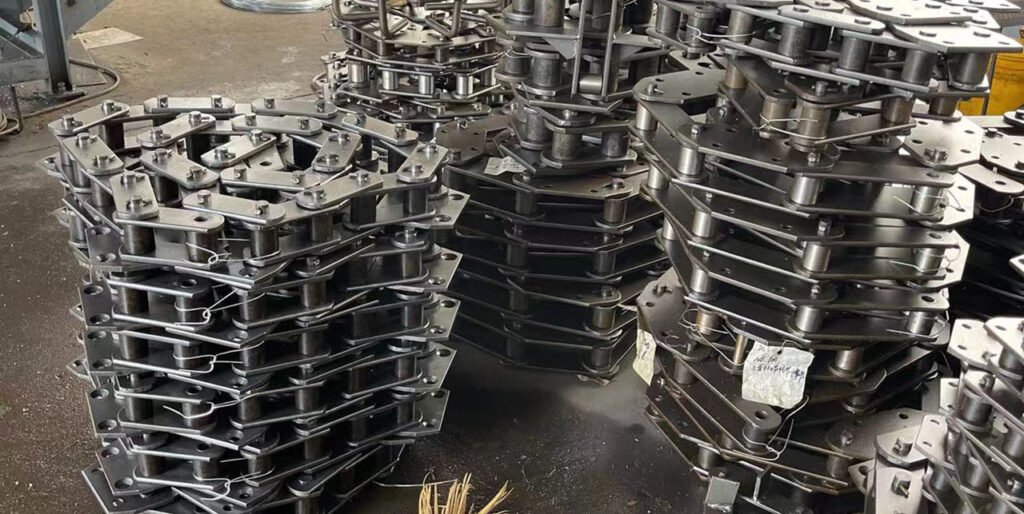
The concepts of single chain vs. double chain and Single-strand plate link chain vs. twin-plate link chain are often confused, but they refer to two entirely different aspects of a bucket elevator’s design. The term single chain or double chain describes the number of traction chains installed in the elevator - one chain running centrally, or two chains arranged symmetrically on both sides like we described above. In contrast, the term Single-strand plate link chain chain and twin-plate link chain refer to the construction of each individual chain link itself. A single-piece plate chain means that each side of the chain link consists of one chain plate, connected to the next link by a pin and bushing. This structure is lightweight, simple, and economical, making it suitable for medium or light-duty elevators where the lifting capacity and tensile load are moderate. A double-piece plate chain, on the other hand, features two parallel plates on each side of the link, joined by the same connecting pin and bushing. This effectively doubles the cross-sectional area and load-bearing strength of the chain, greatly improving its tensile resistance, rigidity, and fatigue life. Because of its superior durability, the double-piece plate chain is widely used in heavy-duty elevators, such as NE and NSE types, handling materials like cement clinker, limestone, or high-density fertilizer granules. In summary, the single/double chain structure refers to how many traction chains are used in one elevator, while the single-piece/double-piece plate chain describes how each of those chains is constructed. Understanding this distinction is essential for selecting the right elevator configuration for different industrial applications.
Single-strand plate link chain and twin-plate link chain comparison table:
Conclusion: The double-plate chain design effectively doubles the load-bearing section area, distributing the tensile stress and reducing fatigue on each plate. This makes it the preferred choice for large-scale fertilizer plants, cement production lines, and mineral systems where continuous heavy-duty conveying is required. By contrast, the single-plate chain remains popular in compact or lower-capacity elevators, offering simplicity, low cost, and easy maintenance.
| Item | Single-strand plate link chain | twin-plate link chain |
| Structure | One plate per side | Two plates per side (reinforced) |
| Strength | Moderate | Very high |
| Weight | Light | Heavy |
| Flexibility | Good | Slightly rigid |
| Cost | Low | High |
| Durability | Normal | Excellent |
| Typical Use | HL / TB type, light-duty | NE / NSE type, heavy-duty |
| Maintenance | Simple | Requires precision alignment |
What is Single-strand plate link chain?
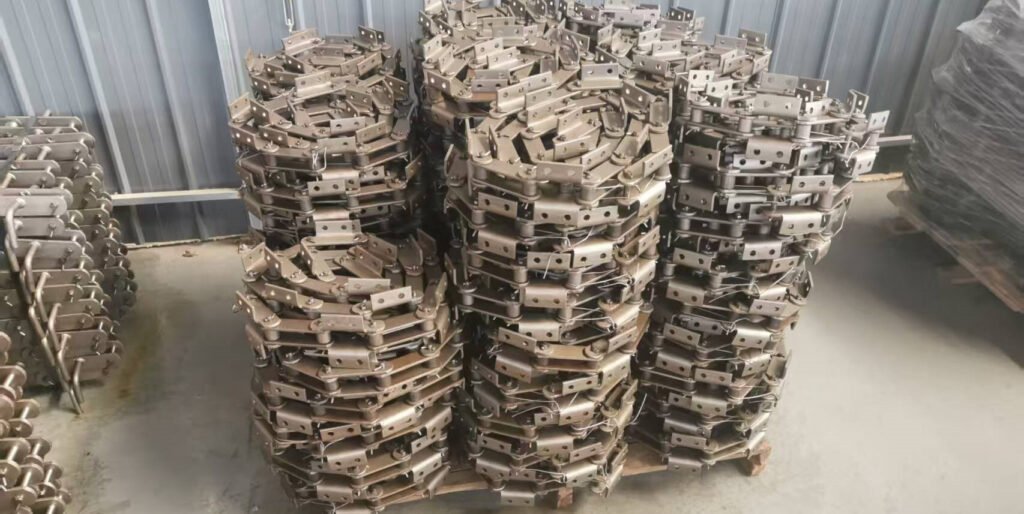
A single-plate chain uses one flat steel plate on each side of the link — that is, one inner plate and one outer plate per side, directly connected by pins and bushings. It is composed of One pair of outer plates and inner plates, forming the chain link. Connecting pin passes through the inner bushing and connects the two plates. The pitch (distance between two pins) determines the spacing of the buckets.
Single-piece plate Material and Processing
Single-strand chain plates are made of medium- or high-strength alloy steel like 40Cr, 20Mn2. Pins and bushings undergo carburizing + quenching or induction hardening for surface hardness HRC 55–60. The plate thickness usually ranges from 6 to 12 mm, depending on the elevator capacity.
Performance characteristic:
| Feature | Description |
| Weight | Lighter chain, easier installation and replacement. |
| Flexibility | Good articulation, less noise, smoother motion. |
| Load Capacity | Moderate — suitable for small to medium elevators (≤160 t/h). |
| Cost | Lower manufacturing cost due to simpler assembly. |
| Weak Point | Lower lateral stiffness and fatigue resistance under long-term heavy load. |
What is twin-plate link chain?
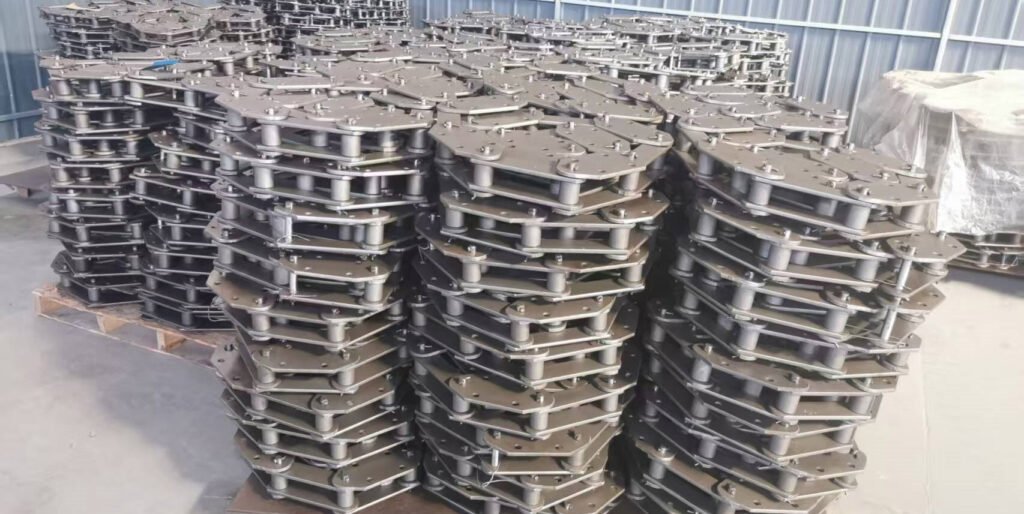
A double-plate chain uses two parallel steel plates on each side of the link, connected together with the same pin and bushing. That means every chain section has two inner plates and two outer plates per side forming a reinforced, double-layered chain link.This structure is commonly used in NE and NSE-type plate chain bucket elevators, which handle high-capacity, heavy materials.
Structural feature:
Each side of the chain link has two overlapping plates, doubling the effective cross-sectional area. Connecting pins are longer to accommodate the dual-plate arrangement. Bushings and rollers are mounted between or outside the plates depending on the design.
Material and Processing:
Chain plates are made of high-strength alloy steel, typically 20CrMnTi, 35CrMo, or 40Mn2, with high fatigue resistance. The double plates undergo integral quenching and tempering, with a hardness of HB 350~450, and tensile strength of ≥900 MPa. Pins and bushings are carburized, quenched, and precision ground for high wear resistance and dimensional accuracy. Chain plate thickness ranges from 8~16 mm, depending on model like NE400, NE500.
Performance Characteristics
| Feature | Description |
| Strength | Significantly higher tensile strength and rigidity; each link can bear 1.5–2× the load of a single-plate chain. |
| Stability | Greater resistance to torsion and side sway; buckets remain well-aligned during lifting. |
| Durability | Superior fatigue life, suitable for continuous heavy-load operation. |
| Weight | Heavier, requires stronger drive and casing design. |
| Cost | Higher manufacturing and assembly cost. |
Flat-Plate Type Bucket Elevator Chain Plate VS Curved-Plate Type Bucket Elevator Chain Plate Comparison
In short: Flat-plate = better sealing and stability; Curved-plate = better material flow and discharge efficiency. The flat-plate type chain plate is mainly used when the bucket has a top cover that overlaps with the connection point-the flat plate provides a stable, sealed interface to prevent leakage. The curved-plate type chain plate, on the other hand, is designed for open-top buckets the curved shape keeps the bucket mouth open and prevents interference during feeding and discharging.
Flat-Plate Type Bucket Elevator Chain Plate
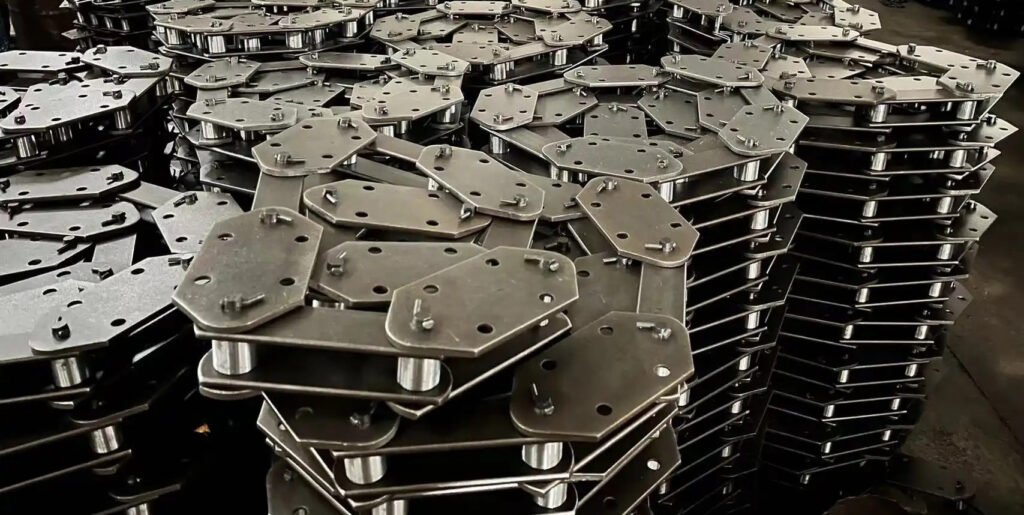
The flat-plate type bucket elevator chain plate is designed with a straight, flat connecting plate between the chains and the buckets. This structure provides a wide and stable mounting surface, which is ideal for buckets equipped with a top cover or overlapping flange. Because the bucket has a cover plate that overlaps with the chain connection point, the flat plate design ensures tight sealing, smooth material flow, and prevents spillage or material leakage at the joint. This type of chain plate is typically used in enclosed-type or high-cleanliness bucket elevators, where material sealing and smooth transition between buckets are important.
Key features of bucket elevator flat plate chain:
- Suitable for buckets with a cover plate structure
- Flat connection plate ensures even load transfer.
- Best suited for buckets with cover or flange at the mounting point.
- Provides better sealing and less wear at the connection area.
- Common in powder, fertilizer, or cement handling elevators.
Curved-Plate Type Bucket Elevator Chain Plate
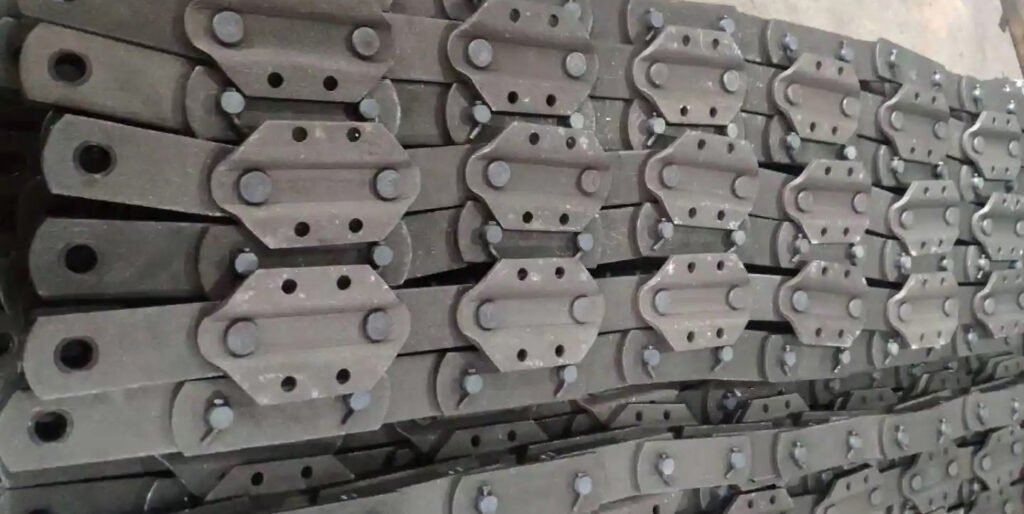
The curved-plate type bucket elevator chain plate features a bent or offset connecting plate, forming a curved transition between the chain and bucket. This design compensates for the absence of a top cover on the bucket and ensures the bucket mouth remains open and unobstructed, reducing interference during material filling and discharging. The curvature allows the bucket to maintain a proper inclination angle, which enhances material collection efficiency and reduces residual buildup at the bucket joint.
Key features of bucket elevator flat plate chain:
- Improves filling and discharge performance.
- Suitable for buckets without a cover plate structure
- Suited for open-top buckets (without overlapping flange).
- Often used in coarse or granular material handling elevators.
- Curved plate allows smooth bucket positioning without obstruction.
Comparison table Flat Chain-Plate vs Curved-Plate Chain
| Item | Flat-Plate Type Chain Plate | Curved-Plate Type Chain Plate |
| Applicable Bucket Structure | Used with buckets that have a cover plate or overlapping flange. | Used with buckets without a cover plate. |
| Plate Shape | The connecting plate is flat and straight, forming a simple plane connection between chain and bucket. | The connecting plate is bent or curved, forming an offset or inclined connection. |
| Mounting Position | The flat plate aligns flush with the bucket’s flange, ensuring tight sealing. | The curved plate provides clearance, keeping the bucket mouth open for unobstructed feeding. |
| Sealing Performance | Excellent — provides tight contact and prevents material leakage between buckets. | Moderate - open connection may allow minor dust leakage, but enhances flow. |
| Material Flow Characteristics | Designed for better sealing and reduced spillage, suitable for fine or powdery materials. | Designed for smoother filling and discharge, suitable for granular or coarse materials. |
| Structural Rigidity | Strong and rigid connection; load is evenly distributed on the flat plate. | Slightly more flexible connection; curvature helps absorb impact and vibration. |
| Typical Applications | Fertilizer plants, cement plants, or environments requiring closed and dust-free conveying. | Bulk material handling of granules or pellets where smooth discharge is critical. |
| Maintenance & Replacement | Easy to assemble and align due to simple geometry. | Slightly more complex to assemble due to curved profile alignment. |
| Design Objective | Focused on tight sealing and stable load transfer. | Focused on smooth bucket filling and discharging performance. |
Technical parameter table for NE type bucket elevator plate chain
| Data | NE15 | NE30 | NE50 | NE50 (Reinforced) | NE100 / NE150 | NE150 (Reinforced) | NE200 / NE300 | NE300 (Reinforced) | NE400 | NE500 |
| Pitch (P) mm | 101.6 | 152.4 | 152.4 | 152.4 | 200 | 200 | 250 | 250 | 300 | 300 |
| Roller Outer Diameter (D₀) mm | 26.5 | 36 | 36 | 36 | 44.5 | 48.5 | 63.5 | 70 | 70 | 75 |
| Pin Diameter (d) mm | 11.5 | 15.5 | 15.5 | 18 | 19.1 | 22.2 | 31.75 | 35 | 35 | 38.5 |
| Pin Length (L) mm | 70 | 90 | 90 | 90 | 120 | 126 | 146 | 170 | 170 | 177 |
| Inner Link Width (W) mm | 27 | 36.5 | 36.5 | 36.5 | 51.8 | 57.6 | 67.4 | 75 | 75 | 82.5 |
| Chain Plate Thickness (T) mm | 6 | 8 | 8 | 8 | 10 | 10 | 12 | 16 | 16 | 16 |
| Inner Chain Plate Width (H) mm | 35 | 50 | 50 | 50 | 60 | 75 | 90 | 100 | 100 | 115 |
| Outer Chain Plate Width (H₁) mm | — | — | 110 | 110 | 125 | 125 | 150 | 180 | 180 | 180 |
| Breaking Load (kN) | 100 | 240 | 240 | 360 | 370 | 550 | 750 |
What are the types of solid bushing roller plate chains?
So we have clearly explained the difference between single plate chain and dual plate chain, it is time to introduce other types of solid bushing roller chains.
Roller Chains
Roller chains are the most common power transmission chains, designed to transfer mechanical motion efficiently between rotating shafts. Built with alternating roller and pin links, they offer high strength, low friction, and long service life. Typical uses include industrial drives, conveyors, and agricultural machinery.
Standard Roller Chains
Standard roller chains are the most widely used power transmission chains, designed according to ISO 606 or equivalent standards. They feature alternating roller and pin links that efficiently transmit motion between sprockets. Their simplicity, interchangeability, and reliability make them ideal for machinery, conveyors, and general industrial drives operating at moderate speeds and loads.
ANSI Standard Roller Chains
ANSI standard roller chains comply with the American National Standards Institute (ANSI B29.1) specifications. These chains are engineered with precise pitch and roller dimensions to ensure perfect interchangeability with ANSI sprockets. They are commonly used in North American industrial systems, agricultural machinery, and material-handling drives where exact standard conformity is required.
BS Standard Roller Chains
BS (British Standard) roller chains conform to BS 228 or ISO 606 dimensions, widely used in Europe and Commonwealth regions. The plates and pins are dimensioned differently from ANSI chains, offering smoother operation and slightly higher fatigue resistance in some designs. They are preferred in European-built mechanical systems, conveyors, and textile or food processing lines.
Heavy Series Roller Chains (H Series)
Heavy Series roller chains feature thicker link plates and larger pin diameters than standard chains, providing increased tensile strength and wear life. Commonly used in high-torque or shock-load applications, such as construction machinery, crushers, and agricultural equipment, the H Series ensures dependable performance under severe working conditions.
HE Series
The HE Series is an enhanced heavy-duty roller chain designed by certain manufacturers for ultra-high fatigue resistance. It typically features shot-peened components, solid bushings, and special alloy steels. These chains are engineered for continuous-duty applications such as steel mills, cement plants, and heavy conveyors where long life and low elongation are critical.
Straight Sidebar Chains
Straight sidebar roller chains replace the traditional contoured outer plates with straight-edged sidebars, giving the chain a flat outer profile. This design provides better guidance on conveyor tracks and is especially suitable for attachment or carrier applications, such as in packaging, assembly lines, and material transport systems.
Super Roller Chains
Super roller chains are premium-strength drive chains developed for higher power transmission without increasing chain size. By using special alloy steel and advanced heat treatment, they offer up to 30% higher fatigue resistance compared to standard chains. Typical uses include heavy-duty machinery, rolling mills, and high-speed production equipment.
Double Capacity Chains
Double Capacity chains are engineered to handle twice the working load of a standard roller chain of the same pitch by incorporating twin strand plates or reinforced components. They are widely used where compact yet powerful drive solutions are needed—such as in compact conveyors, hoisting, and industrial presses.
Freedom Series Self-Lubricating Chains
Freedom Series self-lubricating chains are advanced, maintenance-free designs that feature sintered bushings impregnated with special lubricants. These chains deliver long-term operation without external lubrication, making them perfect for clean environments, food processing, and applications where frequent maintenance is difficult or undesirable.
Lubeless Chains (O-Ring Chain)
Lubeless or O-ring chains utilize synthetic O-rings between the pin and bushing to retain internal lubrication and block contaminants. Originally developed for motorcycles, they are now used in conveyors, packaging, and food systems to minimize wear and maintenance. The sealed structure ensures quiet operation and longer service life even in dusty environments.
Heavy Duty Drive Chains
Heavy Duty Drive Chains are robustly built for high load, high torque drives. Reinforced components and superior surface hardening make them suitable for demanding power transmission, such as in mining conveyors, cement kilns, and heavy-duty machinery where performance reliability is paramount.
Double Pitch Roller Chains
Double pitch roller chains have twice the pitch of standard chains, making them lighter and more economical for low-speed drives and conveying applications. They are commonly used in long-center drives, agricultural equipment, and material-handling conveyors.
Double Pitch Roller Chains (For Drive)
Designed with twice the pitch of standard roller chains, Double Pitch Drive Chains provide economical power transmission for slower-speed shafts and longer center distances. Their lightweight structure reduces cost and inertia, making them a popular choice for agricultural equipment and long-shaft mechanical drives.
Double Pitch Roller Chains (For Conveyor)
Conveyor-type Double Pitch Roller Chains have elongated links and larger rollers to engage with conveyor tracks or guides. They offer smooth and quiet conveying for light to medium loads in packaging, assembly, and warehouse automation lines.
Hollow Pin Chains
Hollow pin chains feature hollow pins that allow easy installation of attachments or cross rods without disassembly. Their flexible design makes them ideal for conveyor systems that require frequent layout changes or customizable attachments.
Hollow Pin Chains
Hollow Pin Chains are designed with hollow pins that allow easy attachment of cross rods, slats, or fixtures without disassembling the chain. This flexibility makes them ideal for conveyors, sorting systems, and production lines requiring frequent tooling or product spacing adjustments.
Double Pitch Hollow Pin Chains
These chains combine the hollow-pin structure with a double pitch configuration, providing a lightweight yet adaptable conveyor solution. They are commonly used in bottle filling lines, assembly conveyors, and light-duty transport systems.
Stainless Hollow Pin Chains
Stainless Hollow Pin Chains offer the same attachment convenience but with corrosion-resistant stainless steel construction. They are suitable for cleanroom environments, food processing, and outdoor installations exposed to moisture or chemicals.
Double Pitch Stainless Hollow Pin Chains
These chains merge stainless steel durability with a long-pitch, lightweight design, offering exceptional corrosion resistance and economy. They are often selected for low-speed conveyors and equipment used in marine, chemical, or hygienic industries.
Corrosion resistant roller chains
These chains are made from or coated with corrosion-resistant materials like stainless steel or nickel plating. They are used in humid, outdoor, or hygienic environments such as food processing, chemical handling, and marine applications.
Stainless Steel Chains
Made entirely from austenitic or martensitic stainless steel, these chains provide excellent corrosion and temperature resistance. Though slightly lower in tensile strength than carbon steel, they are indispensable in food, pharmaceutical, and chemical plants where hygiene and oxidation resistance are priorities.
Nickel-Plated Chains
Nickel-plated chains feature an electroplated nickel surface for improved rust resistance while retaining the strength of carbon-steel construction. They are widely used for outdoor or humid environments, such as packaging lines, bottling systems, and light conveying machinery.
Nickel-Plated Double Pitch Chains
Combining nickel-plating with double pitch design, these chains provide economical corrosion resistance for long-span conveying. Their attractive silver finish and reliable performance make them suitable for light-duty conveying and agricultural machinery.
Side bow chains
Side bow chains are built with increased clearance between components to allow lateral flexing. This enables them to smoothly operate on curved conveyors, commonly seen in bottling, packaging, and assembly lines.
Side Bow Chains
Side Bow Chains are built with slightly extended clearances between pins and bushings, allowing them to flex laterally. This design enables smooth operation on curved conveyors or side-flexing tracks, typically seen in packaging and bottling applications.
Side Bow Double Pitch Chains
These are the double-pitch variants of side bow chains, optimized for low-speed, long-curve conveyor systems. Their extended pitch and lateral flexibility make them ideal for plastic bottle transport, canning lines, and multi-curve conveyor layouts.
Leaf chains
Leaf chains are heavy-duty lifting chains made of link plates and pins only—no rollers. They are designed for high tensile strength and are mainly used in forklifts, hoists, and material-lifting systems. Leaf chains, composed only of link plates and pins (without rollers), are designed specifically for tension lifting applications. They are standardized under ANSI B29.8 and are used in forklifts, hoists, and material-handling equipment due to their high tensile strength and compact construction.
Attachment chains
Attachment chains are roller chains equipped with special plates, brackets, or rollers for conveying materials. They are widely used in production lines, packaging systems, and transport conveyors where customized handling is required.
ANSI Standard Attachment Chains
These chains follow ANSI dimensions but include attachments such as bent or extended plates for conveying. Commonly found in assembly lines, packaging conveyors, and agricultural machinery, they allow customized product handling with reliable power transmission.
BS Standard Attachment Chains
BS-type attachment chains are built to British Standard dimensions, widely used in European-made conveyors and process systems. Their precise attachment options support flexible conveyor designs in manufacturing and bottling industries.
Double Pitch Attachment Chains
Designed for long-distance conveying, Double Pitch Attachment Chains feature elongated links and attachments for lightweight, smooth transport. They are ideal for low-speed packaging and assembly conveyors with minimal maintenance needs.
Chains with Top Rollers
These chains are fitted with rollers on top of the link plates to minimize sliding friction on conveyor tracks. They enable quiet, low-resistance motion, especially in long conveying systems such as electronic component assembly or logistics sorting.
Side Roller Chains
Side Roller Chains have rollers mounted on the side of the link plates to guide movement along rails or curved paths. They are excellent for side-flexing conveyors, bottle handling, and systems requiring both directional control and gentle product movement.
FAQ: Frequently Asked Questions about bucket elevator plate chain:
How to choose the right plate chain for a bucket elevator?
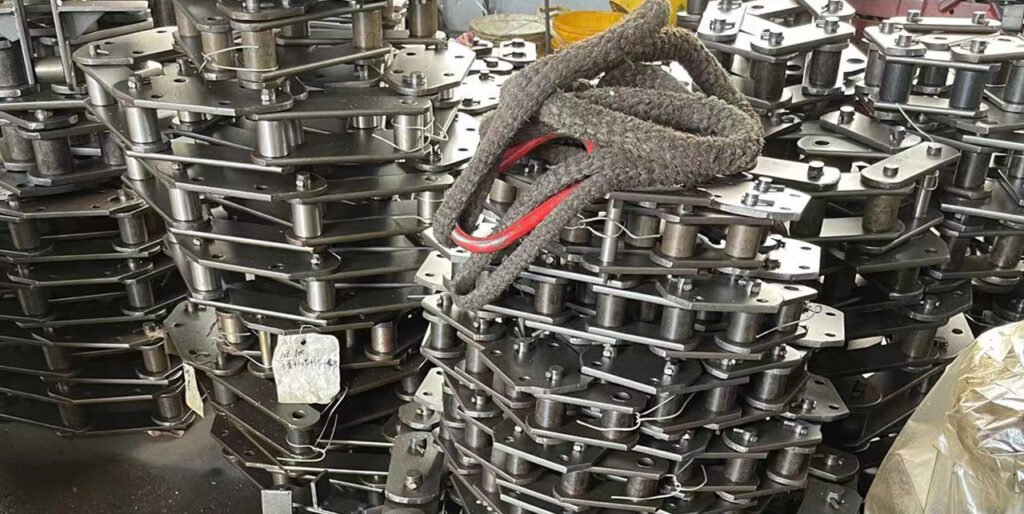
Key selection criteria for bucket elevator chain selection: Single-row chain is suitable for smaller models such as NE15 and NE30, corresponding to conveying capacities below 30 tons per hour. It is suitable for light loads and low-abrasive materials (such as flour and grains), with a simple structure, convenient installation and maintenance, and low cost. Double-row chain is suitable for larger models such as NE50 and above, corresponding to conveying capacities above 30 tons per hour. It can meet the requirements of heavy loads, high-abrasive materials (such as limestone and ore), and lifting heights above 40 meters. It has strong traction and high stability, but the maintenance cost is slightly higher. Single-plate chain has a single-layer structure with average tensile strength and wear resistance. It is suitable for light loads, low-abrasive materials, or materials at normal temperatures. It has low operating resistance, low energy consumption, and low replacement cost. Double-plate chain is composed of two layers of chain plates, with superior tensile strength and wear resistance. It is suitable for heavy loads, high-abrasive materials, or materials at normal temperatures. For high-temperature materials (such as sintered ore and cement clinker) at 200-250℃, the structure has good stability but is relatively heavy and consumes more energy. The industry standard configuration is usually a single row + single plate chain for small models and a double row + double plate chain for large models. For corrosive materials, additional corrosion-resistant plate chains such as 304 stainless steel are required.
What are standard specifications (pitch, capacity, height) for plate chain bucket elevators?
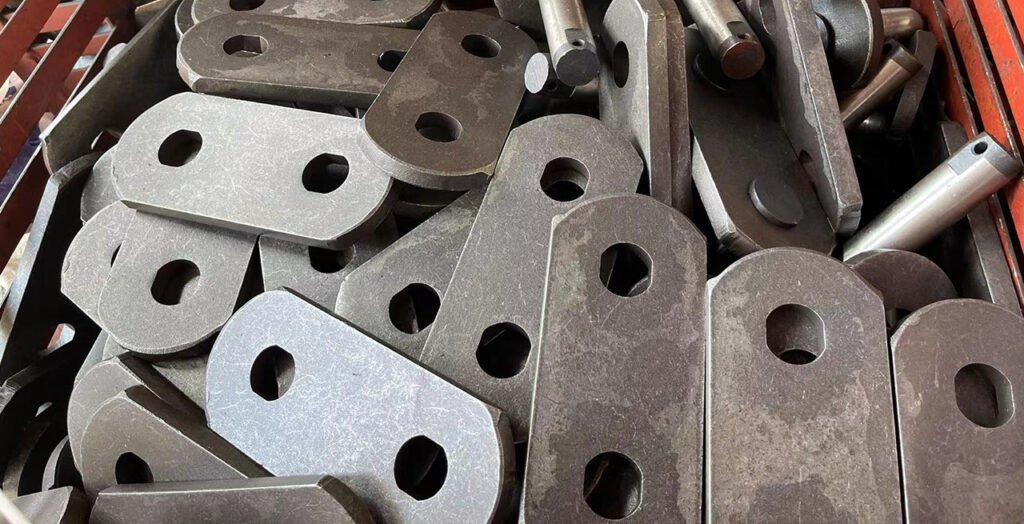
Common plate chain bucket elevators include several mainstream series such as NE, NSE, and TBZ. Different series are suitable for different working conditions, and their standard specifications for plate chain pitch, conveying capacity, and lifting height are clearly distinguished, as detailed below:
- Pitch: The general-purpose NE series is mostly compatible with standard plate chain pitches of 200mm, 250mm, and 320mm; the heavy-duty TBZ series uses a uniform plate chain pitch of 228.6mm across all models; while various general-purpose plate chain bucket elevators, including the NSE series, are also compatible with pitches of 75mm, 100mm, 150mm, and 300mm to meet different load requirements.
- Conveying Capacity: The NE series, as a general-purpose model, covers a conveying capacity of 15-800 m³/h, suitable for medium to large abrasive materials; the high-speed NSE series offers higher conveying efficiency, ranging from 20-1700 m³/h, suitable for large-scale production lines; the TBZ series heavy-duty models have a conveying capacity between 185-600 m³/h, suitable for large materials; the TDG series for light industry is geared towards smaller conveying capacities, typically ranging from 8-100 m³/h, with some large-size TDG models exceeding 1500 m³/h.
- Lifting height: The maximum lifting height of the NE series is no more than 40m; the NSE series, due to its modular design, has a maximum lifting height of 65m, which can meet higher lifting requirements; the lifting height of different models of the TBZ series varies slightly, ranging from 32 to 54m; the standard lifting height limit of the light industrial TDG series is 30m, and some special specifications of TDG models can reach 80m.
What materials/grades of plate chain are best for abrasive or high-temperature environments?
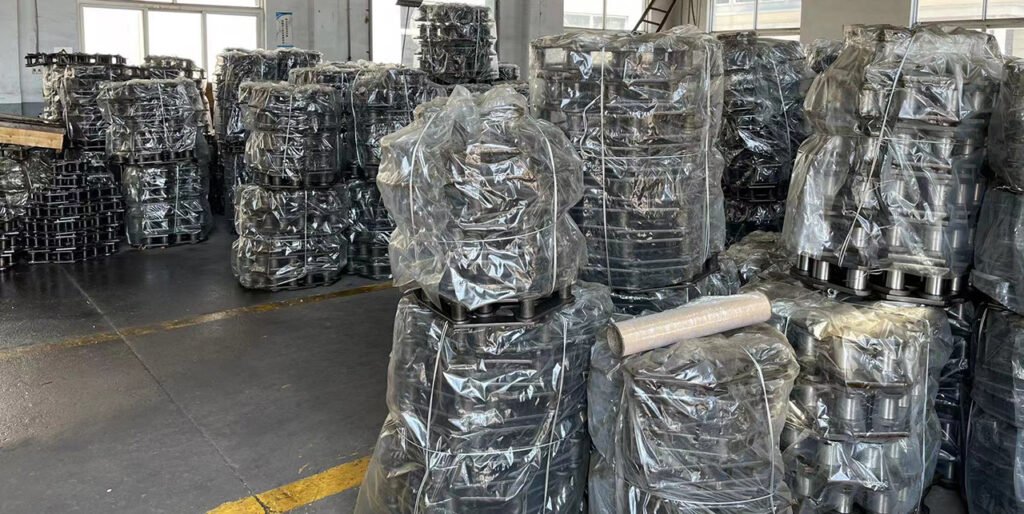
For abrasive and high-temperature environments, the plate chains of bucket elevators are mainly made of alloy steel, stainless steel and special wear-resistant and heat-resistant steel. Each material has corresponding grades and is tailored to different severe working conditions. The specific suitable materials and grades are as follows:
Abrasive environments
Alloy steel:
It is a common material for plate chains in abrasive environments. For example, the chain plates of NE and NSE series plate chain bucket elevators are often made of 45# steel, which can reach a hardness of HRC36 - 42 after heat treatment, and has good shear strength and wear resistance, being suitable for conveying abrasive materials such as limestone and cement clinker. Besides, their external and internal chain plates are made of 40Cr alloy steel; pin shafts are made of 20CrMnMo; sleeves and rollers are made of 20CrMo. After processes like carbonitriding and quenching, the hardness of these components can reach HRC50 - 62, which can effectively resist wear caused by the friction between chain parts and materials during operation.
Special wear-resistant steel:
For scenes with extremely strong material abrasiveness, such as conveying large-grained ore and quartz sand, plate chains made of NM360 and NM400 wear-resistant steel are optional. The average Brinell hardness of NM360 is 360, and the surface hardness of NM400 is between 360 - 420HB. Their mechanical strength is more than twice that of ordinary steel, which can significantly enhance the wear resistance of the plate chain and prolong its service life. In addition, Mn13 high manganese wear-resistant steel is also an excellent choice. It has the characteristic that the higher the external impact, the higher the surface wear resistance, and is very suitable for occasions with strong impact wear.
High-temperature environments
Stainless steel:
304 stainless steel is a common material for plate chains in general high-temperature environments. It has good heat resistance and certain wear resistance, and is suitable for conveying materials with moderate temperature. 420 stainless steel has better heat resistance and wear resistance than 304 stainless steel, which can adapt to higher-temperature working conditions. For more harsh high-temperature environments with corrosive factors, 316 stainless steel can be selected. Due to the addition of molybdenum elements, it not only has heat resistance but also has strong corrosion resistance. In addition, 1Cr18Ni9Ti stainless steel can withstand temperatures above 1000°C, which is applicable to plate chains of bucket elevators for conveying ultra-high-temperature materials such as high-temperature furnace slag.
Alloy steel and special heat-resistant steel:
The alloy steel materials such as 40Cr and 20CrMo mentioned above can adapt to the working conditions of materials below 250°C after special heat treatment, and are widely used in NE series elevators for conveying high-temperature materials such as cement clinker. For plate chain bucket elevators that need to convey materials with temperatures of 600 - 800°C (such as sintered ore in metallurgical plants), plate chains made of special heat-resistant alloy steel can be customized. These steels can maintain structural stability and mechanical properties under ultra-high temperatures without deformation or fracture.
Benefits vs drawbacks of plate-chain bucket elevators compared to belt or link-chain types?
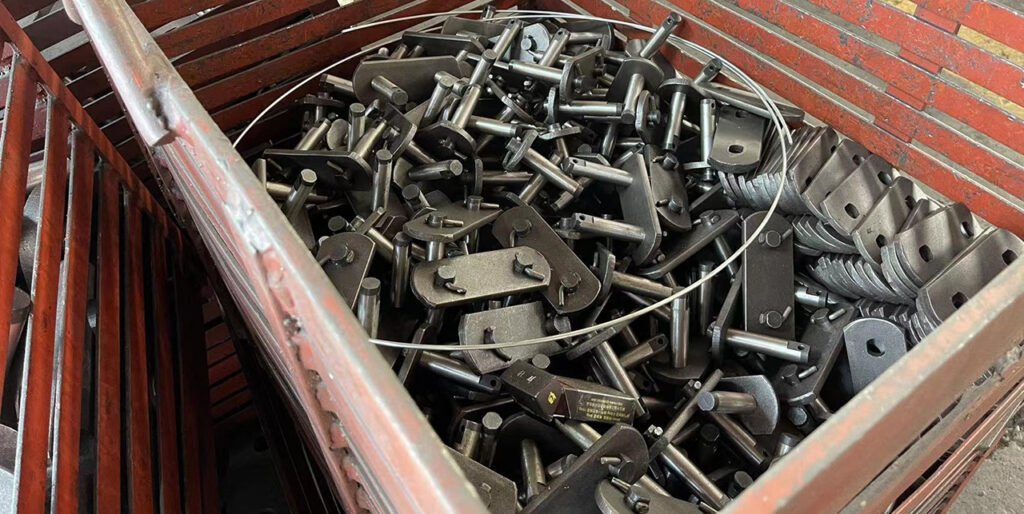
Compared with belt-type and link-chain-type bucket elevators, plate-chain-type ones have distinct advantages and disadvantages in terms of load capacity, wear resistance, maintenance, and application scenarios. The detailed comparison of benefits and drawbacks is as follows:
Adventages:
- Strong load-bearing capacity and wear resistance: The plate chain is composed of multi-layer chain plates and high-strength pins, which can withstand heavy loads and resist wear from abrasive materials (such as ore and cement clinker). It outperforms belt-type elevators (easily worn or torn by sharp materials) and ordinary link-chain types in durability under harsh conditions.
- Stable operation at high temperatures: Plate chains made of alloy steel or heat-resistant steel can adapt to high-temperature environments (up to 600-800°C for customized types), while belt-type elevators are limited by the heat resistance of the belt (generally not exceeding 120°C) and are prone to aging and deformation at high temperatures.
- High lifting height and large capacity: It is suitable for large-scale conveying scenarios with high lifting heights (up to 65m for NSE series) and large capacities (up to 1700m³/h), and has better structural stability than link-chain types when lifting heavy materials at high altitudes.
- Low risk of deviation or slipping: The plate chain meshes closely with the sprocket, avoiding the slipping and deviation problems common in belt-type elevators, especially under heavy load or humid working conditions.
Cons:
- Higher initial investment and equipment weight: The manufacturing cost of plate chains (especially double-plate or alloy steel types) is higher than that of belts and ordinary link chains, and the overall weight of the equipment is larger, requiring more powerful driving systems and higher installation costs.
- Greater noise and energy consumption: During operation, the meshing between the plate chain and the sprocket produces more noise than belt-type elevators (which operate smoothly with low noise). The heavy weight of the plate chain also increases the energy consumption of the driving system compared with lightweight belts.
- Complex maintenance and higher costs: Plate chains require regular lubrication to reduce wear between components, and the replacement of chain links, pins, and sprockets is more cumbersome than replacing belts. The maintenance cycle is shorter than that of belt-type elevators, and the long-term maintenance cost is higher.
- Not suitable for light and fragile materials: The rigid structure of the plate chain may cause collision and damage to light, fragile, or easily broken materials (such as granular food and fragile chemical materials), while belt-type elevators have a softer conveying surface and are more friendly to such materials.
The term “NE” in NE bucket elevator refers to a Plate Chain Type bucket elevator, a designation widely recognized in both Chinese and international standards. The name originated from early “New-type Elevator” classifications found in Japanese (JIS) and Chinese (GB) specifications. In essence, NE represents a new-generation, heavy-duty bucket elevator that utilizes plate link chains—rather than belts—to lift bulk materials through centrifugal or gravity discharge mechanisms.
The “NSE” in NSE bucket elevator stands for High-Speed Plate Chain Type bucket elevator — an upgraded version of the NE series designed for greater lifting capacity and efficiency. It retains the same high-strength plate link chain structure as the NE type but is engineered for higher running speed and increased tensile strength, enabling faster material handling and improved durability. Operating mainly with a centrifugal discharge system, the NSE bucket elevator achieves 1.5–2 times the capacity of equivalent NE models. It is ideal for conveying powdery, granular, or small block materials such as cement, fertilizer, and minerals in heavy-duty, continuous production environments.
A bushed roller type plate chain is a type of plate chain where each link has a bushing and a roller around the pin. The roller turns on the bushing, which reduces friction and wear on the sprocket. This makes the chain more durable and efficient, with typical tensile strengths ranging from 10 to 50 kN depending on the size. It is commonly used in bucket elevators and conveyors that lift powder, granules, or small block materials at speeds up to 2–3 m/s, providing smooth operation and longer service life.
A plate chain bucket elevator is a type of vertical conveyor used to lift bulk materials using buckets attached to a plate link chain. The chain runs over sprockets, carrying the buckets upward, and the material is discharged either by centrifugal force or gravity at the top. These elevators are designed for heavy-duty and high-capacity applications, handling materials like cement, fertilizer, coal, or grains, with lifting heights typically ranging from 10 to 128(for high tower fertilizer) meters and capacities from 50 to 800 m³/h, depending on the chain size and bucket configuration. They are valued for their strength, durability, and ability to operate continuously under harsh conditions.
The installation and tensioning procedure for a bucket elevator plate chain ensures smooth operation, long service life, and safety. First, position the head and boot shafts and mount the sprockets securely. Then, hang the plate chain with attached buckets over the sprockets, making sure the buckets are correctly aligned and oriented. After installation, adjust the tension by moving the take-up or boot pulley until there is slight sag (usually 1–2% of the chain span) to allow for thermal expansion and initial elongation. Rotate the elevator manually to check for smooth movement, proper bucket clearance, and correct chain alignment. Finally, secure all fasteners, lubricate if required, and run the elevator at low speed for initial testing, observing for any abnormal noise or binding before full operation.
Conclusion:
So in this article we have completely explained what plate chain is, and in a cement plant, a bucket elevator's function is to deliver the raw material from ground level to the vertical roller mill for cement grinding, in our next article we will introduce what are the parts of a vertical milling machine for cement and GGBFS slag.