






What is a bucket elevator?
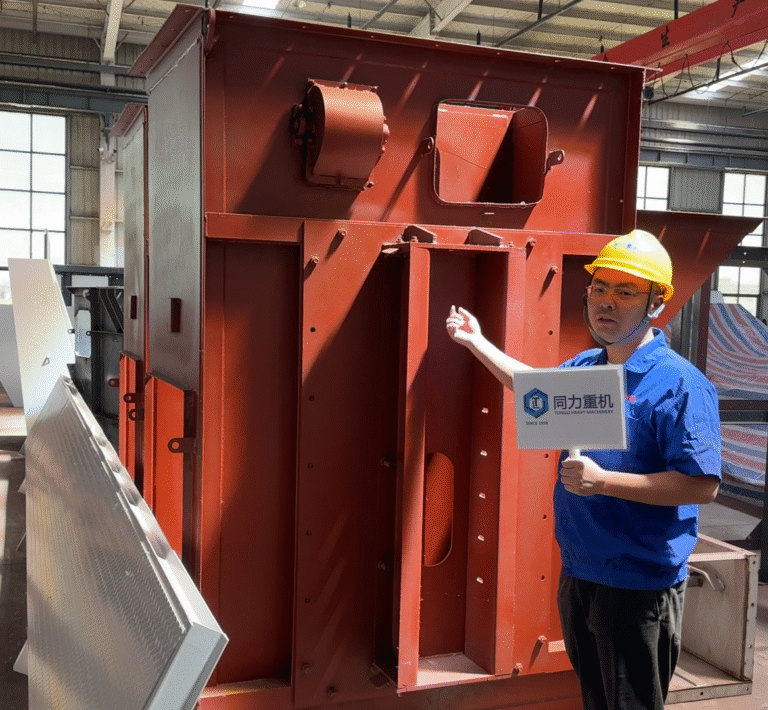
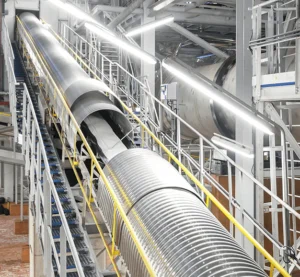
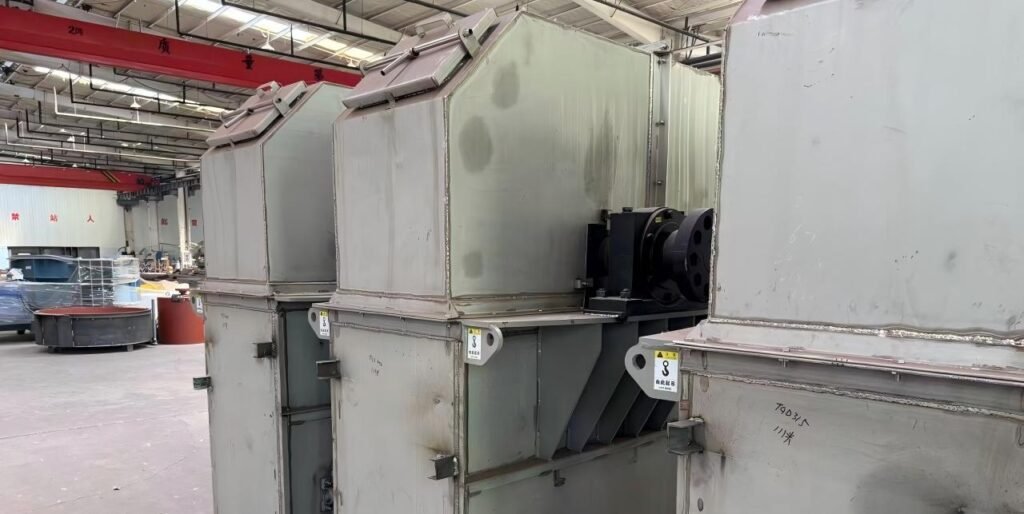
A bucket elevator is a vertical conveying machine used to move bulk solids from a lower elevation to a higher point within a processing or storage facility. Also called a grain leg in the agricultural industry, the bucket elevator system is widely applied in grain handling, commercial agriculture, fertilizer production, feed mills, mining, cement plants, and other bulk material processing industries. Unlike conventional horizontal conveyors, a bucket elevator makes use of vertical space, allowing large quantities of material to be lifted within a relatively small footprint. Depending on the required capacity and application, bucket elevator manufacturers can configure the equipment with a belt, chain, or double strand roller chain drive and select the appropriate elevator buckets for the material being handled.
The basic operating principle is straightforward: material is introduced into the buckets at the boot section, carried upward through the elevator casing, and released at the head section before the empty buckets travel back down for another loading cycle. The method used to discharge the material depends on the elevator design. High-speed centrifugal bucket elevators use the momentum of the buckets to throw material into the discharge chute, while continuous bucket elevators are arranged for controlled discharge as the buckets pass around the head pulley or sprocket. This makes bucket elevators suitable for a wide range of products, including grain, fertilizer, pellets, ore, aggregates, animal feed, clinker, and other granular or powdered materials.
Although the principle is simple, a reliable industrial bucket elevator requires careful consideration of capacity, lifting height, material density, particle size, temperature, abrasiveness, moisture, and discharge characteristics. The bucket size and spacing, belt or chain selection, pulley or sprocket design, drive system, and elevator speed all influence the final conveying performance. A properly designed system can operate continuously and automatically, transferring material to silos, storage bins, hoppers, packaging equipment, or subsequent processing equipment with limited operator intervention.
Long-term bucket elevator performance also depends on maintenance and safety. Components such as elevator buckets, belts, chains, double strand roller chains, sprockets, pulleys, bearings, and drive assemblies should be inspected regularly for wear, misalignment, loose connections, and abnormal operation. Modern bucket elevator systems can incorporate emergency stop devices, speed monitoring, belt alignment protection, temperature sensors, and other safety controls to detect problems and stop the equipment when necessary. With the correct configuration, installation, and preventive maintenance program, an industrial bucket elevator can provide efficient vertical conveying, high availability, and dependable service over extended operating periods.
What is a bucket conveyor?
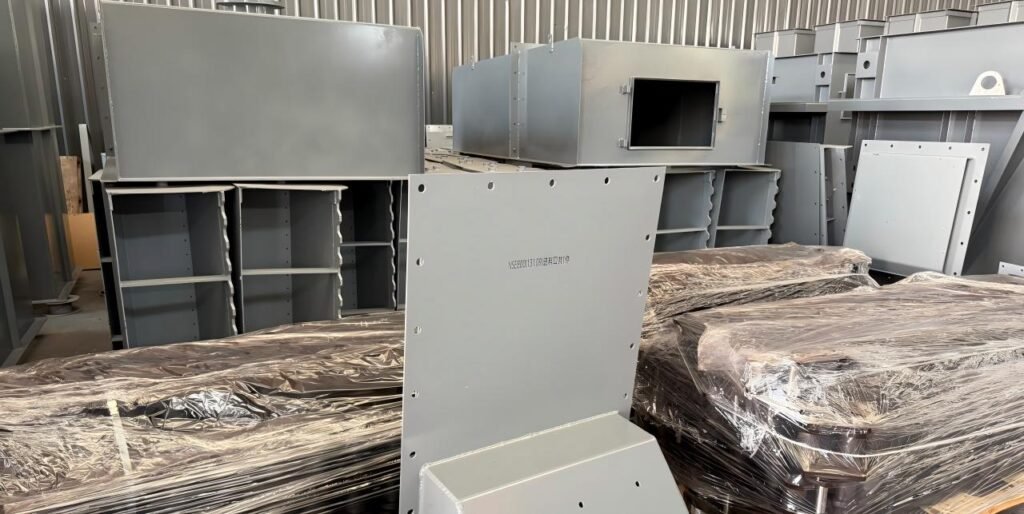
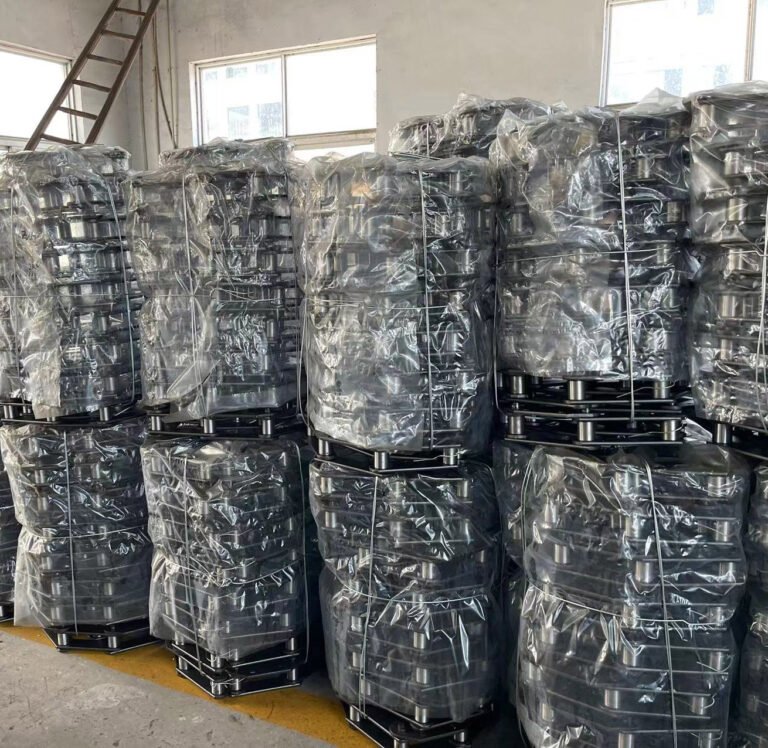
Bucket conveyors are specialized material handling systems designed to move bulk products between different elevations while maintaining controlled and stable material flow. Unlike conventional conveyors that rely on a continuously moving belt, many industrial bucket conveyors use buckets mounted to dual-strand roller chains, allowing the buckets to carry material horizontally, vertically, or along an inclined conveying route. Their robust construction makes them particularly suitable for demanding applications involving heavy, abrasive, or high-temperature materials, while their relatively efficient drive arrangement can provide reliable throughput with controlled energy consumption.
One of the main advantages of a bucket conveyor is the way its buckets handle the conveyed material. The buckets remain in a stable, upright position as they travel along the conveying path instead of continuously tipping the material during transport. This reduces unnecessary spillage and can provide gentler handling, which is particularly beneficial when conveying fragile products or materials where breakage and product loss need to be minimized. At the loading point, material enters the buckets and is carried securely to the designated discharge location, where the bucket geometry and conveyor configuration determine how the material is released.
Although the terms bucket conveyor and bucket elevator are sometimes used interchangeably, the two systems can have different layouts and operating characteristics. A bucket elevator is generally associated with predominantly vertical lifting and is commonly configured for high-capacity elevation of bulk solids. A bucket conveyor, by comparison, can be arranged along horizontal or inclined sections and is often selected when the plant layout requires material to travel between multiple points or elevations without relying solely on a vertical lift. The appropriate configuration depends on the required conveying distance, inclination, material characteristics, capacity, and discharge arrangement.
A typical bucket conveyor consists of a series of interconnected buckets supported and driven by chains, together with loading and discharge sections, sprockets, shafts, bearings, and a drive assembly. Material can be introduced at the loading or boot section and transported continuously along the predetermined route before being discharged automatically at the required point. This design provides a practical solution for conveying dry bulk materials such as aggregates, powders, granules, and other free-flowing products. For materials that are wet, sticky, or sludge-like, however, special consideration is required because buildup inside the buckets can interfere with filling and discharge. By selecting the correct bucket design, chain arrangement, conveying speed, and construction materials, a bucket conveyor can be engineered for dependable operation across a wide range of industrial material handling applications.
Bucket Conveyor vs. Bucket Elevator: Are They the Same?
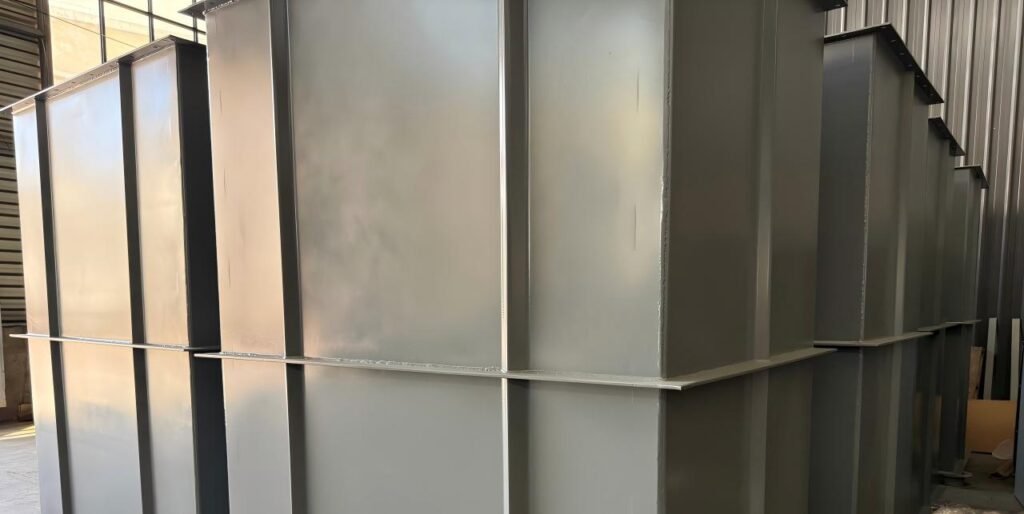
They are related, but they are not necessarily the same thing. The terminology is sometimes used interchangeably, which is why there is confusion. Bucket conveyors and bucket elevators are closely related bulk material handling systems because both use a series of buckets to carry materials from one location to another. In some industries, the terms are used interchangeably, particularly when a bucket conveyor is designed for steep or vertical conveying. However, from an equipment-design and application perspective, they can refer to different configurations.
- A bucket elevator is mainly designed to move bulk materials vertically. It uses a series of buckets attached to a belt or chain to lift materials from a lower point to a higher point. Bucket elevators are commonly used for grain, fertilizer, cement, clinker, aggregates, and other bulk materials.
- A bucket conveyor is a more general term for a bucket-based conveying system. It can transport materials horizontally, vertically, or at an incline, depending on the design. Many industrial bucket conveyors use a dual-strand roller chain to move the buckets along the conveying path.
What Are The Types of Buckets Used in Bucket Elevators?
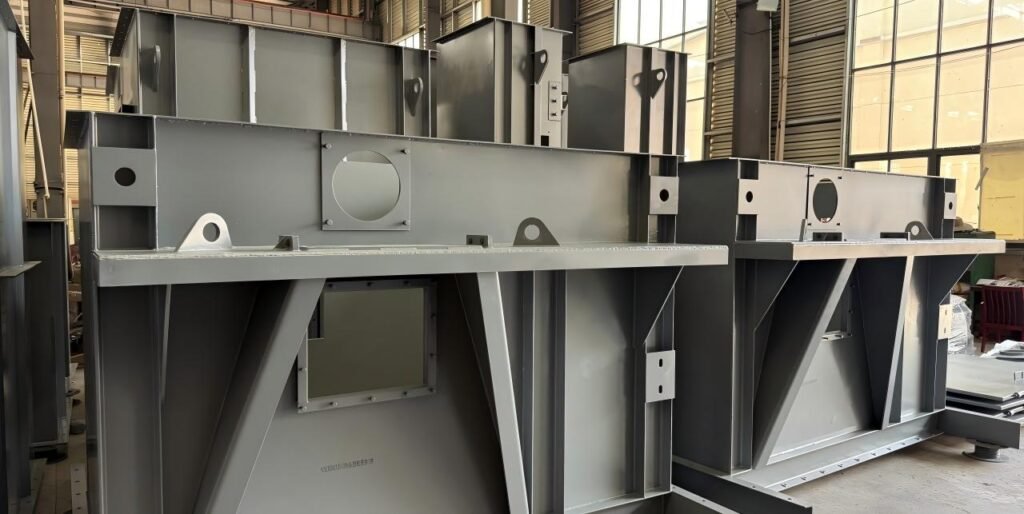
Style AA Welded Buckets
Welded AA buckets are fabricated rather than produced as a single cast component. A typical welded AA bucket is assembled from several formed sections, with the end caps secured to the sides by welding. Straight side walls and a reinforced wear lip provide additional structural strength in applications involving heavy and abrasive materials. This construction makes welded AA buckets particularly useful for high-throughput bucket elevator systems, heavy-duty conveying, equipment modernization, and plant upgrade projects. They can also be fabricated to suit special dimensions or operating requirements where a standard bucket configuration is not suitable.
Style AA Ductile Iron Buckets
For particularly severe operating conditions, Style AA ductile iron (DI) elevator buckets provide an alternative to conventional malleable iron or steel buckets. Ductile iron combines high toughness with strong resistance to impact and abrasion, making it suitable for applications where the bucket is repeatedly exposed to aggressive bulk materials. Compared with standard bucket constructions, the thicker side walls and reinforced front lip provide additional protection against mechanical damage and wear. These heavy-duty buckets are commonly considered for ore processing, cement production, mineral extraction, foundries, power generation, and other heavy industrial plants. Their robust construction can increase bucket service life, reduce replacement frequency, and improve the overall reliability of the bucket elevator system.
Style AA Buckets
The Style AA centrifugal elevator bucket is a deep-profile bucket developed for demanding bulk material handling applications. Its cast iron construction, reinforced rear wall, strong corners, and durable front lip allow it to withstand substantial impact and abrasive conditions. Because of its deep bucket profile, Style AA can carry a relatively large volume of material while operating at higher conveyor speeds. Typical materials include stone, sand, gravel, coal, fertilizer, clay, salt, limestone, cement, and concrete. For this reason, the AA bucket is commonly selected for mining, construction, aggregate processing, and other heavy-duty bulk material handling applications where both capacity and wear resistance are important.
Style MF Buckets
The Style MF (medium front) steel elevator bucket is designed for applications where material needs to be transported efficiently while limiting impact and product degradation. Its reinforced rear wall, strong corners, and thicker front lip provide the necessary durability for continuous industrial operation. The medium front profile offers a practical balance between bucket capacity and gentle material handling. MF buckets are commonly used for products such as pellets, clay, alumina, and fertilizer, making them suitable for agricultural processing, chemical plants, grain handling, and other applications involving relatively delicate or free-flowing materials.
Style MF Welded Buckets
The construction of welded MF buckets is suited to applications where controlled and relatively gentle material handling is required. A formed bucket body is combined with a front plate, with the components continuously welded along the required seams to create a reinforced structure. This design is commonly used for food processing, fertilizer blending, and conveying fragile, coated, or granular products. The front lip, side edges, and sidewalls are generally the areas most exposed to wear during bucket elevator operation. Wear can become particularly severe when the buckets perform a digging action while entering material at the boot. In such conditions, a digger bucket can be installed to handle the additional loading. A welded MF digger bucket is specifically reinforced for this type of operation and is generally made slightly larger than a standard bucket. This helps the bucket withstand the digging forces while reducing interference and wear on neighboring buckets. Selecting suitable wear-resistant materials for the digger bucket can further extend replacement intervals and lower long-term maintenance costs.
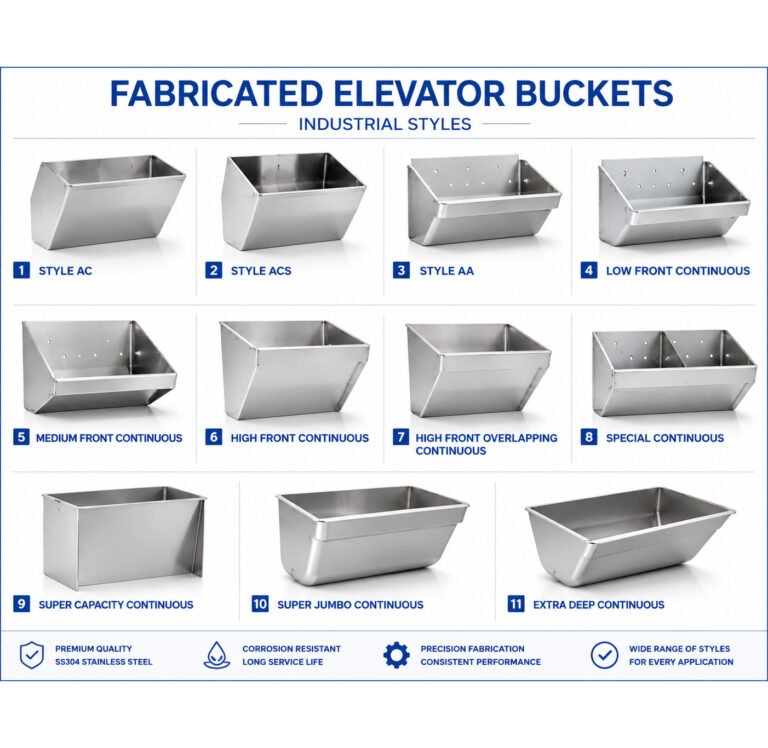
Style AC – Rounded Corner Bucket
A centrifugal elevator bucket with rounded corners, commonly selected for free-flowing bulk materials. The rounded profile promotes smoother material movement and discharge and can be used for grain, fertilizer, feed, and other granular products.
Style ACS – Modified AC Bucket
The Style ACS is a modified version of the AC bucket, developed for applications where the material characteristics require a slightly different bucket profile. It is suitable for various bulk solids and can provide improved handling for materials that are more difficult to discharge cleanly.
Style HF – High Front Bucket
The HF (High Front) bucket has a taller front wall than the MF design. The increased front height provides greater carrying volume and helps retain material during conveying. It is commonly used for granular and powdered products where additional bucket capacity is desirable.
Style C – Continuous Discharge Bucket
The C Type bucket is designed specifically for continuous discharge bucket elevators. Buckets are installed closely together so that material can flow from one bucket into the next and then into the discharge chute. This configuration is commonly used for fragile, sticky, or difficult-to-handle bulk materials.
Style SC – Super Capacity Bucket
The SC (Super Capacity) bucket has a larger carrying profile designed to provide higher capacity within a continuous discharge bucket elevator. It is particularly relevant for high-capacity industrial conveying applications and is one of the bucket profiles worth discussing when comparing North American bucket designs with NE-type bucket elevators.
Low Front (LF) Bucket
A Low Front (LF) bucket has a relatively low front wall and is designed to facilitate material loading and discharge. It can be useful for applications where easy filling and controlled material flow are more important than maximum bucket capacity.
Digger Bucket
A digger bucket is not simply another bucket profile; it is a reinforced bucket intended for the boot section of a bucket elevator where the buckets must dig into the material. Because this area experiences higher impact and abrasion, digger buckets are commonly manufactured with reinforced construction and wear-resistant materials.
Plastic / Polyurethane Elevator Buckets
In addition to traditional steel, cast iron, and ductile iron buckets, plastic elevator buckets and polyurethane elevator buckets are available for applications requiring corrosion resistance, lower weight, reduced noise, or non-sparking operation. They are commonly considered for grain, food, chemical, and other specialized applications. For detail introduction of bucket elevator buckets please check our previous article: Bucket Elevator Buckets: Types, Materials, Selection & Design Guide
What Are The Types of Belts Used in Bucket Conveyors?
The bucket elevator belt is one of the main components responsible for reliable and safe elevator operation. Its construction affects conveying performance, service life, maintenance requirements, and overall system safety, so belt selection should always match the operating conditions of the bucket elevator. Factors such as material type, belt speed, temperature, loading conditions, and the surrounding environment should be considered when choosing the appropriate belt specification. For applications involving grain, agricultural products, food materials, and other potentially combustible bulk solids, additional belt properties may be required. An anti-static bucket elevator belt helps dissipate electrical charges and reduce the risk of static-related ignition, while an oil-resistant construction can improve belt performance where the conveyed material or operating environment contains oils or fats. Flame-retardant bucket elevator belts provide additional protection against fire and are particularly important in installations where combustible dust may be present.
Rubber Belting
Rubber belting is widely used in bucket elevators because it combines good tensile strength with flexibility, wear resistance, and durability. Standard multi-ply rubber elevator belts typically use layers of woven fabric as the internal carcass, providing reliable performance for applications such as grain, feed, fertilizer, aggregates, and other bulk materials. Rubber construction can also offer good resistance to moisture and oil, making it suitable for materials containing fats or for operating environments where conventional PVC belting may not provide sufficient durability.
Steel-Cord Rubber Belting
For high-capacity bucket elevators and installations requiring significant lifting heights, steel-cord rubber belting can provide a higher-strength alternative to conventional fabric-reinforced belts. Instead of multiple layers of textile reinforcement, the belt contains longitudinal steel cords embedded within the rubber. These steel cords provide very high tensile strength while limiting belt elongation, making the construction particularly suitable for heavy-duty applications with high belt tension. Steel-cord rubber belts are commonly considered for large cement plants, mining operations, power plants, fertilizer facilities, and other industrial installations where the bucket elevator operates under heavy loads or at considerable heights. Their low elongation helps maintain stable bucket positioning and reduces the need for frequent belt tension adjustments. However, steel-cord belts generally require more specialized splicing, installation, and inspection procedures than standard fabric-reinforced rubber belts.
Flame-Retardant Rubber Belting
The belt is manufactured with rubber compounds formulated to resist the spread of flame, helping limit the development of a fire if the belt is exposed to an ignition source. This property is particularly important when handling combustible bulk materials such as grain, feed, coal, fertilizer, and other products that may generate combustible dust. Flame-retardant belts are commonly used in grain handling facilities, agricultural processing plants, coal handling systems, and other industrial environments where safety regulations require additional protection against fire. Depending on the application, the belt can also be combined with other properties such as anti-static performance, oil resistance, heat resistance, and high tensile strength.
Specialty Belting Types for Bucket Elevators
Beyond standard PVC and rubber constructions, specialty bucket elevator belts are available for operating conditions that require specific performance characteristics. Heat-resistant belts can be selected for elevated-temperature materials such as clinker or hot aggregates, while chemical-resistant belts are used where aggressive substances may attack conventional rubber. Food-grade white belts are available for applications with strict hygiene requirements. For particularly demanding installations, manufacturers may also offer aramid (Kevlar)-reinforced belts, which provide high tensile strength with relatively low weight and low elongation. The appropriate belt should be selected according to the conveying capacity, lifting height, belt speed, material temperature, abrasiveness, chemical exposure, and required safety properties. Matching the belt construction to the actual operating conditions is essential for achieving long service life and reliable bucket elevator performance.
Belt Selection and Maintenance Tips:
Belt Traction and Tracking
Good belt traction is essential for keeping a bucket elevator running smoothly and transferring power efficiently from the drive pulley to the belt. The take-up system located in the boot section can be adjusted to maintain the correct belt tension and compensate for normal belt elongation. At the head section, suitable pulley lagging, such as rubber or ceramic lagging, improves the grip between the head pulley and the bucket conveyor belt, helping prevent belt slippage during operation. Proper pulley design also plays an important role in belt tracking. A slight crown on the head and boot pulleys helps keep the belt centered as it travels through the bucket elevator. A commonly used guideline is approximately 1/8 inch of crown for every 12 inches of belt width, although the appropriate design should ultimately be determined according to the belt construction and manufacturer recommendations. Correct tracking reduces the tendency of the belt to move sideways, minimizes edge wear, and helps extend belt service life.
Initial Belt Stretch and Tension Adjustment
A new bucket elevator belt may experience some permanent elongation during its initial operating period. Depending on the belt construction, an initial stretch of approximately 1.5–2% can occur during the first few days or weeks of operation. For this reason, the belt tension should be checked after commissioning and adjusted through the take-up system when necessary. Additional elongation later in the belt's service life should not simply be treated as normal stretching. Repeated or excessive tension adjustments may indicate that the internal reinforcement is beginning to deteriorate. Fabric-reinforced belts containing polyester or nylon carcasses, for example, can lose their original strength as the belt ages. Monitoring belt elongation allows potential problems to be identified before they develop into a major belt failure.
Inspecting Belt Wear and Damage
Regular inspection is an important part of bucket elevator belt maintenance. Operators should look for abnormal stretching, damaged belt covers, edge wear, cracking, separation, cover loss, and exposed internal reinforcement. These signs can indicate that the belt is approaching the end of its service life or has been subjected to operating conditions beyond its intended design. Damage to the belt cover can also affect its performance. Loss of the protective cover may reduce static conductivity, decrease traction, and expose the internal reinforcement to further deterioration. In applications handling combustible dust, maintaining the belt's anti-static and flame-resistant properties is particularly important because uncontrolled static discharge can increase fire or explosion risks. Early detection of belt damage can therefore improve both equipment reliability and plant safety.
So How To Select?
For food-processing applications, belts may need to comply with applicable FDA or USDA requirements, while installations in potentially explosive environments may require equipment and components suitable for ATEX requirements. Working with an experienced bucket elevator belt manufacturer or supplier can help ensure that the belt construction matches the equipment and operating conditions. Regular inspection, correct belt tension, proper tracking, and preventive maintenance can significantly reduce unexpected belt failures and unplanned downtime. A well-maintained belt also protects other bucket elevator components from unnecessary stress, helping improve overall system reliability and extend the service life of the conveying equipment.
What are the types of bucket elevators?
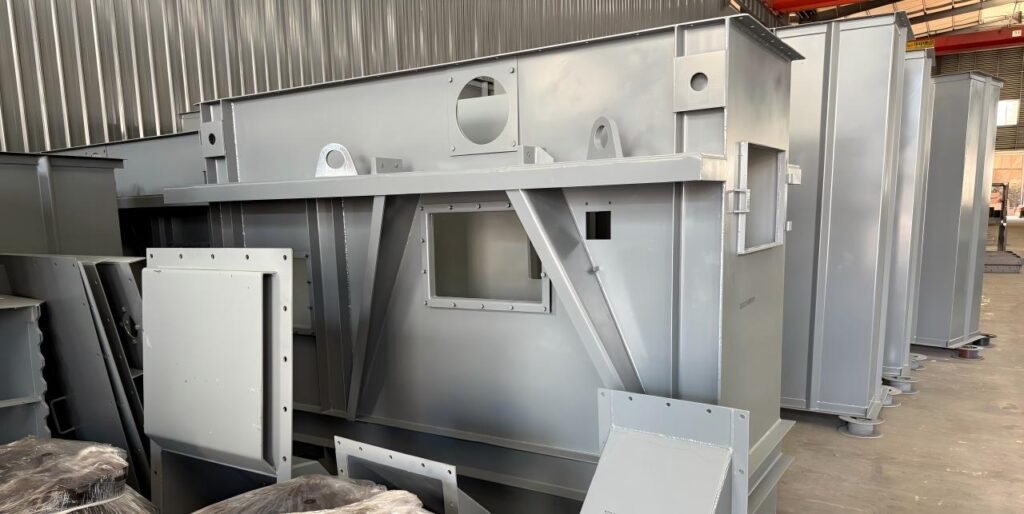
Continuous Bucket Elevators
Designed for applications where product protection is a priority, continuous bucket conveyors provide a controlled method of transporting fragile and lightweight bulk materials in either vertical or horizontal directions. Instead of leaving significant spaces between individual buckets, the buckets are arranged closely along the conveying chain or belt, creating a more continuous carrying surface that helps contain the product and reduce spillage. Most continuous bucket elevator systems operate at relatively low speeds of approximately 3–5 feet per second. This slower movement provides a smoother conveying action and reduces excessive aeration, impact, and product degradation. As a result, they are frequently selected for sensitive materials including breakfast cereals, granulated sugar, powdered chemicals, and small glass fragments. The enclosed construction also helps control dust and maintain a cleaner working environment. Depending on the layout and installation requirements, continuous bucket elevators can be manufactured in S, Z, or C configurations and supplied in different capacities. Their combination of gentle material handling, controlled discharge, and reduced spillage makes them suitable for industries such as food processing, plastics, mining, and chemical manufacturing. As enclosed conveyor systems, they provide an effective solution when both reliable bulk material transport and material cleanliness are important considerations.
Centrifugal Bucket Elevators
Centrifugal bucket conveyors are commonly used for the efficient handling of free-flowing bulk materials where high conveying rates and dependable discharge are required. In a bucket elevator system, a series of buckets is mounted at regular intervals on a high-speed belt or chain. As the buckets pass through the loading point, they collect the material and carry it upward. When they reach the head pulley, centrifugal force throws the material from the buckets into the discharge outlet, allowing the elevator to achieve rapid and effective bulk material transfer. Depending on the material and equipment design, centrifugal bucket elevators can operate at speeds of approximately 350 feet per minute, while certain models handling lighter products can reach speeds of up to 1,000 feet per minute. They are also capable of handling materials with bulk densities of up to about 100 pounds per cubic foot. Any material that does not immediately enter the discharge stream can be collected and returned to the conveying path, helping improve material recovery and overall operating efficiency. Because of their high-speed conveying capability and durable construction, centrifugal bucket conveyors are widely applied in grain handling, mineral processing, sugar refining, fertilizer production, and chemical industries. They can accommodate different operating requirements, from moderate conveying rates to high-throughput applications. The enclosed metal housing keeps the material contained during elevation, helping limit dust release and reducing direct operator contact with the conveyed product. This combination of high capacity, reliable centrifugal discharge, and enclosed operation makes centrifugal bucket elevators a practical solution for continuous and automated transport of granular bulk materials.
Chain Bucket Elevators
Chain bucket elevators are engineered for demanding bulk material handling applications where dry, coarse, or highly abrasive products must be raised vertically over considerable heights. Built with heavy-duty chains and durable buckets, these systems are well suited to high-capacity and high-lift conveying duties in cement, lime, mineral processing, aggregate, and power generation plants. Compared with belt-driven designs, chain systems provide greater resistance to abrasive particles that can accelerate belt wear. Regular maintenance, including the application of heavy grease, is important for protecting the chains against wear caused by dust, grit, and other abrasive materials. The capacity of a chain bucket elevator is closely related to the size and arrangement of its buckets. Larger bucket volumes can provide greater conveying capacity when the other operating parameters are properly matched. Some advanced designs can also combine the functions of an elevator and conveyor, allowing material to be discharged at selected points along the conveying route. In continuous-duty applications, chain-driven buckets provide strong and dependable lifting performance, while certain configurations use two continuous chains to support and move the buckets through the system. Depending on the required material flow and layout, chain bucket elevators may follow C-shaped or Z-shaped conveying paths, allowing material that does not discharge immediately to be returned to the conveying cycle and improving overall material recovery. A typical system can include a feed hopper, vibrating feeder, elevator buckets, gear motor drive, inspection doors, discharge chutes, and a sliding drawer designed for convenient cleaning. Chain tension can also be adjusted manually, providing operators with a practical method for maintenance, alignment, and operating adjustment. This robust construction makes chain bucket elevators a reliable choice for continuous material transport under demanding industrial conditions.
Belt Bucket Elevators
Belt bucket elevators are widely used for vertical transportation of both wet and dry bulk materials, including raw minerals, ores, fertilizers, grains, and other fine or granular products. Compared with chain-driven elevators, belt-based systems provide smoother operation in wet applications because they generate less friction and generally require less lubrication and routine maintenance. The conveyor belt is engineered to maintain secure contact with the head pulley, allowing the bucket elevator to lift and discharge material reliably, including powders and materials with a certain degree of stickiness. Another advantage of belt bucket elevators is their compact vertical configuration, which allows high conveying capacity while occupying relatively little floor space. This makes them particularly useful in processing plants where available installation space is limited. Their enclosed construction also makes them suitable for handling fine particles and thin slurries while helping contain dust and reduce exposure to the surrounding environment. For continuous processing applications, regular cleaning and emptying of the elevator boot can help prevent material accumulation and keep the system operating efficiently. Easy access for cleanout and maintenance can further reduce downtime and support a stable, uninterrupted material flow.
Positive discharge bucket conveyors
Positive discharge bucket conveyors are designed for applications where bulk products must be transferred carefully while minimizing the risk of product damage, contamination, or material buildup. Rather than relying solely on centrifugal force like a conventional centrifugal elevator, this type of bucket elevator system uses an additional sprocket or cam arrangement at the discharge point to mechanically empty each bucket. The positive discharge action is particularly useful when handling sticky, fragile, irregular, or difficult-to-flow materials that may otherwise remain inside the bucket and cause packing or blockages. These elevators typically operate at relatively low speeds of around 2–4 feet per second. To achieve the required conveying capacity at these slower operating speeds, they are commonly equipped with larger buckets. This configuration makes them well suited for products such as breakfast cereals, snack foods, pet food, nuts, dried fruits, pharmaceutical products, and other delicate granular materials. The controlled discharge process reduces excessive impact and provides more consistent product handling, which is especially important where product quality and cleanliness are closely controlled. Although positive discharge bucket elevators generally have a higher initial cost than some other types of material conveying equipment, their specialized discharge mechanism provides greater reliability for difficult applications. They can also be configured to meet different plant layouts and material-handling requirements. For food processing, packaging, pharmaceutical production, and specialty chemical applications, positive discharge conveyors offer a dependable solution when gentle handling, accurate discharge, and protection against product degradation are key priorities.
Bucket lifters
Bucket lifters provide a simple and cost-effective solution for raising small quantities of bulk materials and ingredients in food processing, chemical production, and other industrial facilities. Compared with larger traditional elevators, these systems are intended for lower-capacity and more controlled conveying duties. They can be used for a wide range of products, including seeds, powders, granules, small components, and pharmaceutical ingredients, particularly where controlled and gentle material handling is important. A typical bucket lifter consists of a geared motor, a series of buckets, a belt or chain, and a sturdy steel support frame. Material can be accurately metered into the buckets at the loading point, allowing consistent lifting and controlled discharge. Once the buckets reach the top of the lifting path, they automatically tip and release the material into a hopper, silo, conveyor, or other receiving equipment before returning to the loading position for the next cycle. Depending on the application and hygiene requirements, bucket lifters can be manufactured from stainless steel or painted structural steel. Stainless steel construction is especially suitable for sanitary processing environments where corrosion resistance, easy cleaning, and hygiene are essential. With their straightforward design, controlled operation, and relatively low investment cost, bucket lifters are a practical choice for precise, small-volume material transfer.
Multiple-Discharge Bucket Conveyors
Multiple-discharge bucket conveyors are designed to provide greater flexibility when one incoming material stream needs to supply several downstream processes. Instead of installing an individual conveying line for each destination, a single bucket elevator system can raise the material and distribute it through multiple discharge points. This makes the equipment particularly useful for feeding several bagging machines, mixers, packaging lines, storage units, or other process equipment from one centralized conveying system. By incorporating multiple discharge locations and, where required, more than one feeding point, these conveyors can simplify plant layouts and reduce the amount of additional conveying equipment required. This can help save valuable floor space while also lowering installation and equipment costs. The ability to direct material to different destinations makes the system well suited to production facilities where conveying routes or product destinations frequently change.
Indexing Bucket Conveyors
Indexing bucket conveyors are a specialized type of bucket conveyor designed to move products in controlled, predetermined increments rather than in a continuous flow. Each bucket carries a measured amount of material and advances to a specific position before stopping or slowing for accurate filling, weighing, inspection, or discharge. This precise movement makes indexing bucket conveyors particularly suitable for food processing, packaging, pharmaceuticals, and other applications where consistent product dosing and positioning are important. By combining accurate material handling with gentle bucket movement, these systems can improve production control while reducing product damage, spillage, and unnecessary material transfer.
Skid Steer Conveyor Buckets
Skid steer conveyor buckets are specialized attachments designed to combine the loading capability of a skid steer loader with controlled material conveying. Mounted to the front of a skid steer, these buckets can collect and transport materials such as soil, sand, gravel, mulch, aggregate, and other bulk products, then discharge them at a controlled rate or into a designated area. Unlike a conventional bucket that simply dumps its contents, a conveyor bucket uses an integrated conveyor or metering mechanism to provide more controlled material placement. This makes skid steer conveyor buckets useful for landscaping, construction, agricultural, roadwork, and other applications where precise and efficient bulk material distribution is required.
Horizontal elevators
Horizontal elevators differ from conventional lifts by using cable-free linear motor technology, similar to the propulsion principle used in magnetic levitation transportation systems. Instead of relying on traditional ropes and a single vertical cabin, this rope-less, multi-cabin configuration allows elevator cabins to move vertically and horizontally through the same building structure. By making more efficient use of available shaft space, these systems can accommodate up to 50% more load than conventional elevators, providing a new approach to internal transportation in high-rise buildings, manufacturing facilities, and logistics centers. The technology is capable of transporting both passengers and goods, offering greater flexibility for complex buildings and industrial environments. Its ability to create continuous or looped movement paths can simplify internal logistics and improve the flow of people and materials between different areas. For demanding commercial and industrial applications, horizontal elevators provide an advanced solution for optimizing internal material handling assets while supporting efficient, future-ready bulk material and passenger transportation.
Industries Using Bucket Elevators and Bucket Conveyors
- Cement Industry – Handling clinker, cement, limestone, gypsum, and other raw materials.
- Fertilizer Industry – Conveying NPK fertilizer, urea, potash, phosphate, and granular fertilizer products.
- Grain and Agriculture Industry – Elevating wheat, corn, rice, barley, seeds, and other agricultural products.
- Mining Industry – Transporting ores, minerals, concentrates, and other bulk materials.
- Aggregate Industry – Handling sand, gravel, crushed stone, and construction aggregates.
- Chemical Industry – Conveying powders, granules, chemical compounds, and other bulk chemical products.
- Food Processing Industry – Moving cereals, sugar, flour, nuts, dried fruits, and other food ingredients.
- Pet Food Industry – Handling dry pet food, pellets, and granular ingredients.
- Power Generation Industry – Conveying coal, ash, limestone, and other solid fuels or process materials.
- Steel and Metallurgical Industry – Handling iron ore, pellets, coke, slag, and other raw materials.
- Lime Industry – Elevating limestone, quicklime, hydrated lime, and related products.
- Plastic and Polymer Industry – Transporting plastic pellets, granules, powders, and additives.
- Pharmaceutical Industry – Handling powders, granules, and pharmaceutical ingredients under controlled conditions.
- Sugar Industry – Conveying raw sugar, refined sugar, and sugar crystals.
- Biomass Industry – Handling wood pellets, biomass fuel, chips, and agricultural residues.
- Waste Recycling Industry – Elevating processed waste, recyclable materials, RDF, and other bulk products.
- Glass Industry: Continuous bucket elevators are generally better suited to glass-handling applications because they can handle abrasive materials more effectively while providing controlled material movement. Centrifugal bucket elevators are less suitable where the conveyed glass or related material could cause significant abrasive wear.
- Pulp and Paper Industry: Continuous bucket elevators are a suitable choice for high-volume handling of abrasive materials such as wood waste, bark, and ash. For smaller quantities of relatively non-abrasive materials, such as certain fuels, centrifugal bucket elevators can provide faster and more efficient conveying.
What Are the Advantages of Bucket Elevators/Conveyors?
Innovative Design:
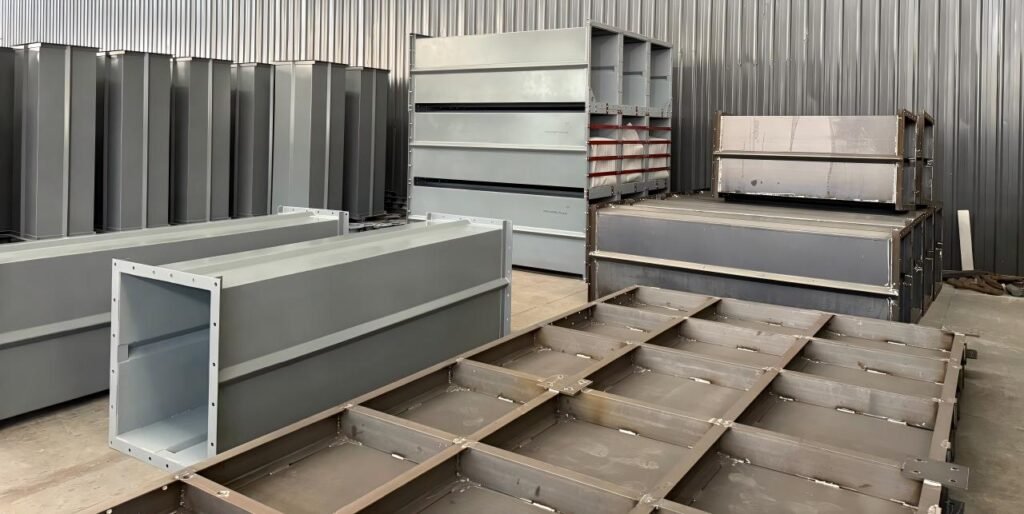
Bucket elevators can be engineered with different bucket shapes, sizes, materials, and configurations to match specific conveying requirements and project conditions. Their vertical arrangement also gives them a relatively compact footprint compared with many conventional conveying methods, helping plants save valuable floor space. The reduced equipment footprint can also contribute to lower energy consumption and more efficient use of the available production area. Depending on the application, bucket elevators can be manufactured from materials such as stainless steel, carbon steel, and other specialized materials to provide the required durability and performance.
Easy Transportation:
One of the main advantages of a bucket conveyor system is its ability to continuously move large quantities of bulk material at a controlled rate. Automated bucket handling can transport products faster and more consistently than manual handling while also reducing unnecessary product contact. A continuous bucket elevator can therefore provide high conveying capacity and help manufacturing facilities improve productivity and maintain a competitive operating advantage.
Cost Effective:
Industrial plants and manufacturing facilities are constantly looking for ways to control operating expenses, labor requirements, and overall project costs. Bucket elevators can contribute to these goals by providing reliable, automated bulk material transportation with relatively efficient use of space. Their enclosed and weather-resistant construction allows them to handle large capacities while supporting streamlined material flow and reducing the need for manual transportation. With proper maintenance, regular cleaning, and timely inspection, a bucket elevator can provide many years of service, making it a practical long-term investment for industrial material handling.
Large Capacity:
The conveying capacity of a bucket elevator depends on factors such as bucket or hopper volume, bucket spacing, operating speed, and material characteristics. As the buckets continuously collect and elevate bulk materials, the system can handle substantial quantities without requiring large horizontal conveying areas. The robust construction of bucket elevators also helps maintain stable operation and reduce material spillage. Properly selected buckets and operating conditions can further minimize product damage while ensuring reliable vertical transportation.
Weather Resistance:
Outdoor and industrial conveying equipment may be exposed to changing environmental conditions, making reliable operation an important consideration. Many bucket elevators are designed with durable, enclosed structures that allow them to operate under a wide range of weather conditions. This can help prevent rain, wind, and other environmental factors from interrupting material transportation and reduce the risk of production delays. For facilities that depend on continuous material flow, weather-resistant construction provides an additional level of operational reliability.
Space Saving / Compact Footprint:
One of the biggest advantages of a bucket elevator system is its ability to achieve vertical material transportation while occupying very little floor space. Instead of requiring a long horizontal conveying route, the equipment uses a compact vertical arrangement to reach significant lifting heights. This makes bucket elevators particularly valuable in plants where available floor space is limited or where multiple pieces of equipment must be installed within a confined production area. Their small footprint also provides greater flexibility when planning plant layouts and connecting the elevator with hoppers, silos, conveyors, mills, and other process equipment.
High Lifting Height:
Bucket elevators are specifically designed to move bulk materials through substantial vertical distances while maintaining a continuous and controlled material flow. Depending on the elevator type, construction, bucket design, and material characteristics, the equipment can be configured for different lifting heights to meet specific plant requirements. This makes them an effective solution for transferring materials from ground-level equipment to elevated silos, storage systems, processing units, or other high-level discharge points without requiring extensive horizontal conveying equipment.
Enclosed Material Handling / Reduced Material Spillage:
The enclosed structure of a bucket conveyor keeps the material contained throughout most of the conveying process, helping reduce spillage, dust emissions, and direct exposure to the surrounding working environment. Since the material is carried inside individual elevator buckets rather than moving openly along a conveyor surface, the risk of material loss during vertical transportation can be significantly reduced. Proper bucket loading, belt or chain tension, and discharge design can further improve material retention and minimize buildup around the equipment. This enclosed configuration is especially beneficial when handling dusty, fine, valuable, or contamination-sensitive bulk materials.
What Are the Disadvantages of Bucket Elevators/Conveyors?
Higher Initial Investment:
A bucket elevator system may require a higher upfront investment than some conventional horizontal conveying equipment, particularly when the application involves high lifting heights, large capacities, heavy-duty construction, or customized configurations. The total project cost can also include supporting structures, access platforms, drives, electrical equipment, and safety components.
Limited Material Compatibility:
Bucket elevators are not suitable for every type of bulk material. Extremely sticky, wet, oversized, or poorly flowing products may cause problems with bucket filling, discharge, or material flow. Proper selection of the bucket design, belt or chain type, operating speed, and discharge method is therefore important to achieve reliable performance.
Risk of Bucket or Belt/Chain Damage:
Continuous operation with abrasive materials, excessive loads, foreign objects, or improperly adjusted components can accelerate wear on the buckets, belts, chains, pulleys, and sprockets. In severe cases, damaged components can lead to unplanned downtime. Regular inspection and correct operating conditions are essential for extending the service life of the conveying system.
Difficult Access for Maintenance:
Because bucket elevators are installed vertically and can extend to considerable heights, some components can be difficult to reach during inspection or repair. Access to the head section, drive assembly, bearings, and other elevated components may require maintenance platforms, ladders, lifting equipment, and appropriate safety measures, which can increase maintenance complexity.
Not Ideal for Fragile Materials in High-Speed Operation:
High-speed centrifugal bucket elevators may not be the best choice for fragile or friable products because rapid bucket movement and centrifugal discharge can create additional impact and product degradation. Materials that are easily broken may require a continuous bucket elevator, positive discharge design, or lower operating speed to achieve gentler handling.
Material Buildup in the Boot Section:
Wet, sticky, fine, or cohesive materials can accumulate in the boot section of a bucket conveyor, particularly when the material does not discharge cleanly from the buckets. Excessive buildup can reduce conveying efficiency, interfere with bucket movement, and increase the risk of blockage or component wear. Regular boot cleaning, proper feed control, and an appropriate discharge design can help minimize these problems.
Bucket Conveyor/Elevator Maintenance Guide
For detailed bucket elevator maintenance guide please check our previous article: "Bucket Elevator Maintenance Checklist"
Bearing Lubrication:
A bucket elevator normally has four primary bearing lubrication points: two located at the head bearings and two at the boot take-up bearings. Under normal operating conditions, each lubrication point should be serviced at least once per week. The appropriate bearing lubricant should be selected according to the operating temperature range specified in the equipment manual. For the correct lubricant type, application method, and maintenance interval, always follow the manufacturer's guidelines for the specific bucket elevator.
Chain and Sprocket Drive Lubrication:
Although the chain drive uses splash lubrication, the lubricant level should be checked before every operating shift. The oil level can normally be viewed through the sight gauge installed on the side of the drive guard. If the level is below the specified range, add the recommended oil before starting the equipment. Lubrication requirements can vary between designs, so the bucket elevator manual should be consulted for the specified oil type and service procedure. The drive oil should also be inspected periodically for contamination. If dirt, moisture, metal particles, or other pollutants are found, the contaminated oil should be drained, the system flushed, and fresh lubricant added. The drive chain should be cleaned by immersing it in a nonflammable solvent to remove accumulated debris, dirt, and water from the bushings, rollers, and sidebars. The sprockets should be cleaned at the same time, followed by thorough drying of both the chain and sprockets with compressed air.
Drive Chain and Sprocket Inspection:
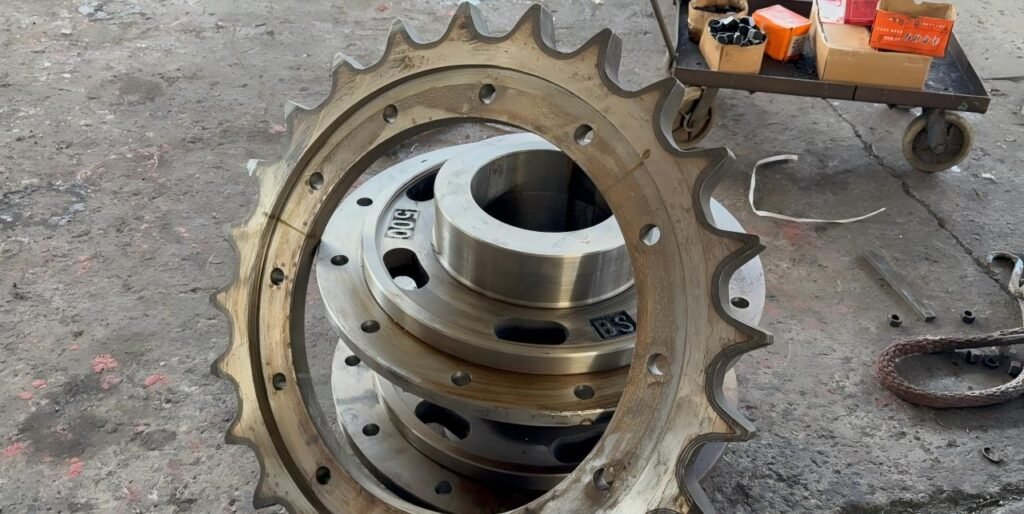
Regular inspection of the drive chain and sprockets is necessary to identify excessive wear, deformation, or damage before it leads to a failure. For a detailed inspection, remove the upper drive guard and slowly rotate the chain and sprockets so that the complete contact surfaces can be examined. This provides an effective method for checking the condition of these components. Any chain or sprocket showing significant wear or damage should be replaced promptly. During the inspection, also confirm sprocket and shaft alignment and check the chain slack to ensure correct drive alignment and reliable operation. Refer to the bucket elevator manual and manufacturer's maintenance procedures for detailed inspection and replacement requirements.
Performance Tips for Bucket Elevators/Conveyors
To maintain reliable performance and extend the service life of bucket elevators and conveyors, operators should follow a combination of proper operating practices and preventive maintenance. Avoid overloading the equipment and maintain a consistent feed rate so that the elevator buckets can be filled efficiently without excessive spillage or drive overload. For belt bucket elevators, regularly check belt tension and alignment to prevent slippage, tracking problems, and premature belt wear. For chain bucket elevators, inspect chain tension, chain elongation, sprocket alignment, and chain lubrication to maintain smooth power transmission. Bearings, gearboxes, pulleys, sprockets, and other moving components should also be inspected and lubricated according to the manufacturer's recommendations. Material buildup in the boot section and around the discharge area should be removed regularly, particularly when handling wet, sticky, or fine materials. Operators should also monitor the system for abnormal vibration, unusual noise, excessive temperature, material leakage, or reduced conveying capacity, as these can indicate developing mechanical problems. Worn or damaged elevator buckets, belts, chains, sprockets, bearings, and bucket bolts should be replaced before they cause secondary damage or unexpected downtime. Finally, maintaining the correct operating speed and selecting the appropriate bucket design for the material can improve filling efficiency, reduce product degradation, and ensure stable conveying performance. A structured preventive maintenance schedule, combined with regular inspections and proper operating procedures, is one of the most effective ways to maximize bucket elevator performance and service life.
Safety Guide for Bucket Elevator/Conveyors
- Lockout/Tagout (LOTO): Always shut down, isolate, and lock out the electrical and mechanical energy sources before inspection, cleaning, lubrication, or repair.
- Prevent Unexpected Startup: Ensure the bucket elevator or conveyor cannot restart automatically while personnel are working on or inside the equipment.
- Install Proper Guards: Keep guards installed around moving components such as belts, chains, sprockets, pulleys, shafts, and drive assemblies.
- Use Appropriate PPE: Wear required personal protective equipment (PPE), including safety glasses, gloves, safety footwear, hearing protection, and dust protection where applicable.
- Working at Height: Use properly designed platforms, ladders, handrails, and fall-protection equipment when accessing elevated sections of the bucket elevator.
- Inspect Before Operation: Check buckets, belt or chain, bearings, pulleys, sprockets, drive components, fasteners, and access doors before starting the equipment.
- Keep the Boot Section Clean: Remove accumulated material from the boot to reduce the risk of blockage, overheating, and mechanical damage.
- Control Dust: Use suitable dust collection and ventilation systems when handling fine or dusty materials to maintain a safe working environment.
- Explosion Protection: When conveying combustible materials such as grain, coal, or certain chemical powders, consider appropriate grounding, spark prevention, explosion venting, and other required dust explosion protection measures.
- Do Not Enter Moving Equipment: Never enter, climb into, or reach inside a bucket elevator or conveyor while it is operating.
- Emergency Stop Systems: Ensure emergency stops and other safety devices are installed, accessible, clearly identified, and tested regularly.
- Avoid Overloading: Operate the equipment within its rated capacity and maintain a controlled feed rate to prevent blockages, drive overload, and excessive material spillage.
- Monitor Abnormal Conditions: Stop and inspect the system if unusual vibration, noise, temperature, belt slippage, chain movement, or material leakage is detected.
- Follow Manufacturer Instructions: Maintenance, inspection, lubrication, and operating procedures should always comply with the bucket elevator manufacturer's guidelines and applicable local safety standards.
Bucket Elevator Sizing
Bucket elevator sizing is the process of determining the appropriate bucket size, bucket spacing, belt or chain speed, conveying capacity, elevator height, and drive power required to transport a specific bulk material vertically. Proper sizing ensures that the bucket elevator can achieve the required throughput without excessive power consumption, material spillage, wear, or mechanical loading. The basic capacity of a bucket elevator is a function of bucket volume and the number of buckets passing a given point over a specific period of time. In simple terms, the more material each bucket can carry and the more buckets that pass through the elevator per minute, the greater the conveying capacity
Bucket Elevator Capacity Calculation
The volumetric throughput of a bucket elevator is determined by the bucket volume, linear speed, and bucket spacing. The basic relationship is:
- Volumetric throughput = Bucket volume × Linear speed ÷ Bucket spacing
The result can be expressed in m³/h or ft³/h, depending on the units used for the calculation. In actual operation, the nominal bucket volume should normally be adjusted by the fill efficiency or percent fill, because buckets are rarely filled to 100% of their geometric capacity. The gravimetric throughput, or mass conveying capacity, is calculated by multiplying the volumetric throughput by the bulk density of the material:
- Gravimetric throughput = Volumetric throughput × Bulk density
For example, if a bucket elevator provides a volumetric throughput of 100 m³/h and the bulk density of the material is 0.8 t/m³, the theoretical gravimetric throughput is approximately 80 t/h. This is why the same bucket elevator can have different mass capacities when handling materials with different bulk densities.
Bucket Volume and Bucket Size
Bucket volume is determined by the geometry of the bucket, including its width, depth, profile, and projection. Different bucket elevator manufacturers offer a range of bucket dimensions to suit different capacities and materials. Common bucket lengths include 6, 8, 10, 12, 14, 16, and 18 inches. Selecting a larger bucket does not automatically mean that the bucket elevator is better or more suitable. Bucket size must be matched with the required capacity, material characteristics, bucket spacing, casing dimensions, belt or chain strength, and discharge arrangement. Larger buckets can provide greater capacity, but they may also require larger elevator casings and stronger mechanical components.
Bucket Fill Efficiency
The actual capacity of a bucket elevator depends not only on the geometric bucket volume but also on its fill efficiency, or percent fill. Fill efficiency represents the percentage of the bucket's nominal volume that is effectively occupied by material during normal operation. Material properties have a significant effect on bucket filling. Free-flowing materials such as grain and some granular products can generally achieve good bucket filling, while wet, sticky, cohesive, or poorly flowing materials may require a lower design fill factor. Particle size, moisture content, material flowability, loading conditions, and elevator speed should therefore be considered when establishing the effective bucket volume. The effective bucket volume can be expressed as:
- Effective bucket volume = Nominal bucket volume × Fill efficiency
Using a realistic fill factor is important because using the full geometric bucket volume in the capacity calculation can significantly overestimate the actual operating capacity.
Belt Speed and Bucket Elevator Sizing
Belt speed is another major factor affecting bucket elevator capacity because it determines how many buckets pass a given point during a specific period. For a given bucket spacing, increasing the belt speed increases the number of buckets passing per minute and therefore increases theoretical conveying capacity. As a general reference, belt speeds are typically 225 to 500 feet per minute for a centrifugal discharge bucket elevator and approximately half that speed for other bucket elevator designs. The actual operating speed depends on the bucket profile, material characteristics, discharge method, elevator height, pulley diameter, and required capacity. Higher speeds can increase capacity, but speed should not be increased without considering the effects on material degradation, dust generation, bucket loading, belt wear, chain wear, discharge performance, and drive power. The optimum belt speed is therefore a balance between required capacity and reliable operation.
Bucket Spacing and Bucket Projection
Bucket spacing directly affects the number of buckets that pass through the elevator per unit of time. Closer bucket spacing means more buckets can be installed on the belt or chain, potentially increasing the elevator's capacity. Typical spacing between buckets is approximately 2 times the bucket's projection. The bucket projection is the measurement from the bucket's outer lip to the belt. For example, if the bucket projection is 8 inches, a typical bucket spacing may be approximately 16 inches. The actual spacing may vary depending on the bucket design, discharge arrangement, belt speed, material characteristics, and manufacturer requirements. Adequate spacing is necessary to prevent interference between adjacent buckets and to provide sufficient clearance for proper loading and discharge.
Material Characteristics for Bucket Elevator Sizing
The material being conveyed is one of the most important considerations when sizing a bucket elevator conveyor. The design should account for bulk density, particle size, maximum lump size, moisture content, temperature, abrasiveness, corrosiveness, flowability, and material degradation characteristics. For example, a bucket elevator handling cement, clinker, limestone, coal, fertilizer, grain, or other bulk materials may require different bucket profiles, materials of construction, speeds, fill factors, and discharge arrangements. Abrasive materials may require wear-resistant buckets and reinforced components, while high-temperature materials may require specially selected belts, chains, buckets, bearings, seals, and other components.
Elevator Height and Mechanical Design
The required elevator lift height must also be considered during sizing. Increasing the vertical lift increases belt or chain tension and can affect the required drive power, take-up arrangement, shaft loading, bearing selection, belt strength, chain strength, and structural design. A high-capacity, high-lift bucket elevator therefore requires more than simply increasing bucket size. The complete mechanical system must be capable of handling the resulting loads throughout continuous operation.
Discharge Type and Bucket Elevator Speed
The discharge method also affects bucket elevator sizing. A centrifugal discharge bucket elevator normally operates at a higher speed, allowing the material to be discharged as the buckets pass around the head pulley. Other designs may use slower speeds and different bucket arrangements to achieve controlled discharge. The bucket profile, bucket spacing, belt or chain speed, and head pulley geometry must work together to provide reliable discharge. Incorrect sizing can result in poor material discharge, carryback, material buildup, reduced capacity, or excessive impact and wear in the head section.